Regulatory pressure, fermentation advances, and sustainable packaging demand drive PHBH adoption in Germany, positioning it as a key growth engine through 2036
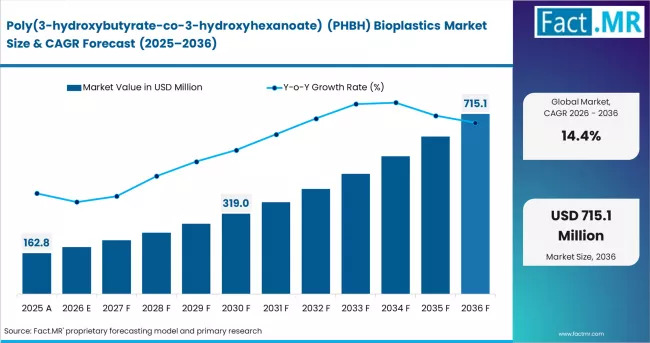
ROCKVILLE, MD, UNITED STATES, April 20, 2026 /EINPresswire.com/ — According to the latest analysis by Fact.MR, the global Poly(3-hydroxybutyrate-co-3-hydroxyhexanoate) (PHBH) bioplastics market reached USD 145.2 million in 2025 and is projected to grow to USD 162.8 million in 2026, ultimately attaining USD 624.7 million by 2036, expanding at a CAGR of 14.4%.
Get detailed market forecasts, competitive benchmarking, and pricing trends: https://www.factmr.com/connectus/sample?flag=S&rep_id=14759
Germany is emerging as a key European growth hub, registering a CAGR of 14.9%, driven by circular economy mandates, sustainable packaging demand, and advanced polymer processing capabilities.
The market is undergoing structural transformation as industries shift from petrochemical plastics toward biodegradable, fermentation-derived polymers, supported by regulatory frameworks and material innovation.
Quick Stats
Market Size (2025): USD 145.2 million
Market Size (2026): USD 162.8 million
Forecast Value (2036): USD 624.7 million
CAGR (2026–2036): 14.4%
Incremental Opportunity: ~USD 462 million
Leading Segment: Food Packaging (41% share)
Leading Application: Packaging Films (34% share)
Leading Region: Europe (Germany as key growth engine)
Key Players: Kaneka Corporation, BASF SE, TotalEnergies Corbion, Danimer Scientific Inc., RWDC Industries Ltd.
Executive Insight for Decision Makers
The PHBH market is transitioning from niche biodegradable polymer adoption to industrial-scale commercialization, particularly in Europe.
Strategic Imperatives:
Invest in fermentation yield optimization to improve cost competitiveness
Align products with existing extrusion and thermoforming infrastructure
Target high-value applications such as food packaging and coated paper
Risk of Inaction:
Companies failing to adapt risk losing relevance as regulatory bans on conventional plastics intensify, particularly across Germany and the EU.
Market Dynamics
Key Growth Drivers
Stringent EU regulations promoting biodegradable materials
Rising demand for sustainable flexible packaging solutions
Advancements in microbial fermentation technologies
Compatibility with conventional plastic processing equipment
Key Restraints
Higher production cost compared to polyethylene and polypropylene
Limited large-scale production infrastructure
Performance consistency challenges in certain applications
Emerging Trends
Integration of PHBH in multi-layer packaging structures
Expansion of bio-based feedstock supply chains
Development of high-barrier biodegradable films
Strategic collaborations between biotech firms and packaging companies
Segment Analysis
Leading Segment: Food Packaging (41%)
Driven by demand for compostable, high-barrier materials for perishable goods
Leading Application: Packaging Films (34%)
Supported by compatibility with blown film extrusion processes
Fastest-Growing Segment:
Agricultural films and molded biodegradable products
Processing Methods:
Injection molding
Film extrusion
Thermoforming
Strategic Importance:
Packaging remains the primary commercialization pathway, offering scalability and regulatory alignment.
Supply Chain Analysis (Critical Insight)
Raw Material Suppliers:
Renewable feedstocks (sugars, plant oils)
Industrial biotechnology inputs
Manufacturers / Producers:
Biopolymer companies using microbial fermentation (e.g., Kaneka Corporation, RWDC Industries Ltd.)
Converters / Processors:
Packaging manufacturers using extrusion, molding, and compounding technologies
Distributors:
Specialty polymer distributors supplying to packaging and consumer goods industries
End-Users:
Food & beverage companies
Consumer goods manufacturers
Agricultural sector
Who Supplies Whom:
Feedstock suppliers → Biopolymer producers → Packaging converters → FMCG companies → End consumers
Germany plays a critical role as a processing and conversion hub, integrating imported biopolymers into high-value packaging applications.
Pricing Trends
PHBH is positioned as a premium biodegradable polymer
Pricing influenced by:
Feedstock costs
Fermentation efficiency
Scale of production
Certification requirements (e.g., compostability standards)
Margin Insights:
Higher margins in specialty packaging applications
Commodity substitution remains limited due to price sensitivity
Regional Analysis
Top 5 Countries by CAGR (2026–2036)
United Kingdom – 15.3%
Germany – 14.9%
United States – 14.1%
France – 13.8%
Japan – 13.2%
Germany Insights
Strong regulatory push via EU Circular Economy Action Plan
Advanced polymer processing infrastructure
High adoption in flexible packaging and molded products
Developed vs Emerging Markets
Developed markets: Driven by regulation and sustainability mandates
Emerging markets: Growth linked to cost reduction and technology transfer
Competitive Landscape
Market Structure: Moderately fragmented
Key Players
Kaneka Corporation
BASF SE
TotalEnergies Corbion
Danimer Scientific Inc.
RWDC Industries Ltd.
CJ CheilJedang Corporation
TianAn Biologic Materials Co. Ltd.
Bluepha Co. Ltd.
Biome Bioplastics Ltd.
Newlight Technologies Inc.
Competitive Strategies
Fermentation technology innovation
Expansion of production capacity
Strategic partnerships with packaging firms
Focus on performance consistency and certification compliance
Strategic Takeaways
For Manufacturers
Scale fermentation processes to reduce cost
Focus on application-specific polymer grades
For Investors
Target companies with proprietary biopolymer technologies
Focus on Europe, especially Germany, for regulatory-driven growth
For Marketers / Distributors
Emphasize sustainability and compliance benefits
Target premium packaging segments
Future Outlook
The PHBH bioplastics market is set to transition toward mainstream adoption, particularly in Europe.
Key Trends Ahead:
Expansion of industrial composting infrastructure
Integration into circular packaging ecosystems
Breakthroughs in cost-efficient fermentation technologies
Germany will remain a strategic innovation and adoption hub, bridging regulatory frameworks with industrial execution.
Conclusion
The PHBH bioplastics market represents a high-growth, regulation-driven transformation opportunity. Germany’s strong policy support, advanced manufacturing ecosystem, and packaging industry leadership position it at the forefront of this transition.
Companies that invest early in technology scalability, cost optimization, and application alignment will capture disproportionate value in this rapidly evolving market.
Why This Market Matters
As global industries accelerate toward sustainability, PHBH bioplastics offer a viable pathway to replace conventional plastics without compromising performance.
For decision-makers, this market is not just about materials it is about future-proofing business models in a circular economy.
Unlock 360° insights for strategic decision making and investment planning: https://www.factmr.com/checkout/14759
To View Our Related Report:
Bioplastics Market: https://www.factmr.com/report/bioplastics-market
Bioplastics For Packaging Market: https://www.factmr.com/report/bioplastics-for-packaging-market
Trifluoromethyl-substituted Aromatics Market: https://www.factmr.com/report/trifluoromethyl-substituted-aromatics-market
Tetrahydrofurfuryl Alcohol (THFA) Market: https://www.factmr.com/report/tetrahydrofurfuryl-alcohol-thfa-market
S. N. Jha
Fact.MR
+1 628-251-1583
email us here
Legal Disclaimer:
EIN Presswire provides this news content “as is” without warranty of any kind. We do not accept any responsibility or liability
for the accuracy, content, images, videos, licenses, completeness, legality, or reliability of the information contained in this
article. If you have any complaints or copyright issues related to this article, kindly contact the author above.

Media gallery