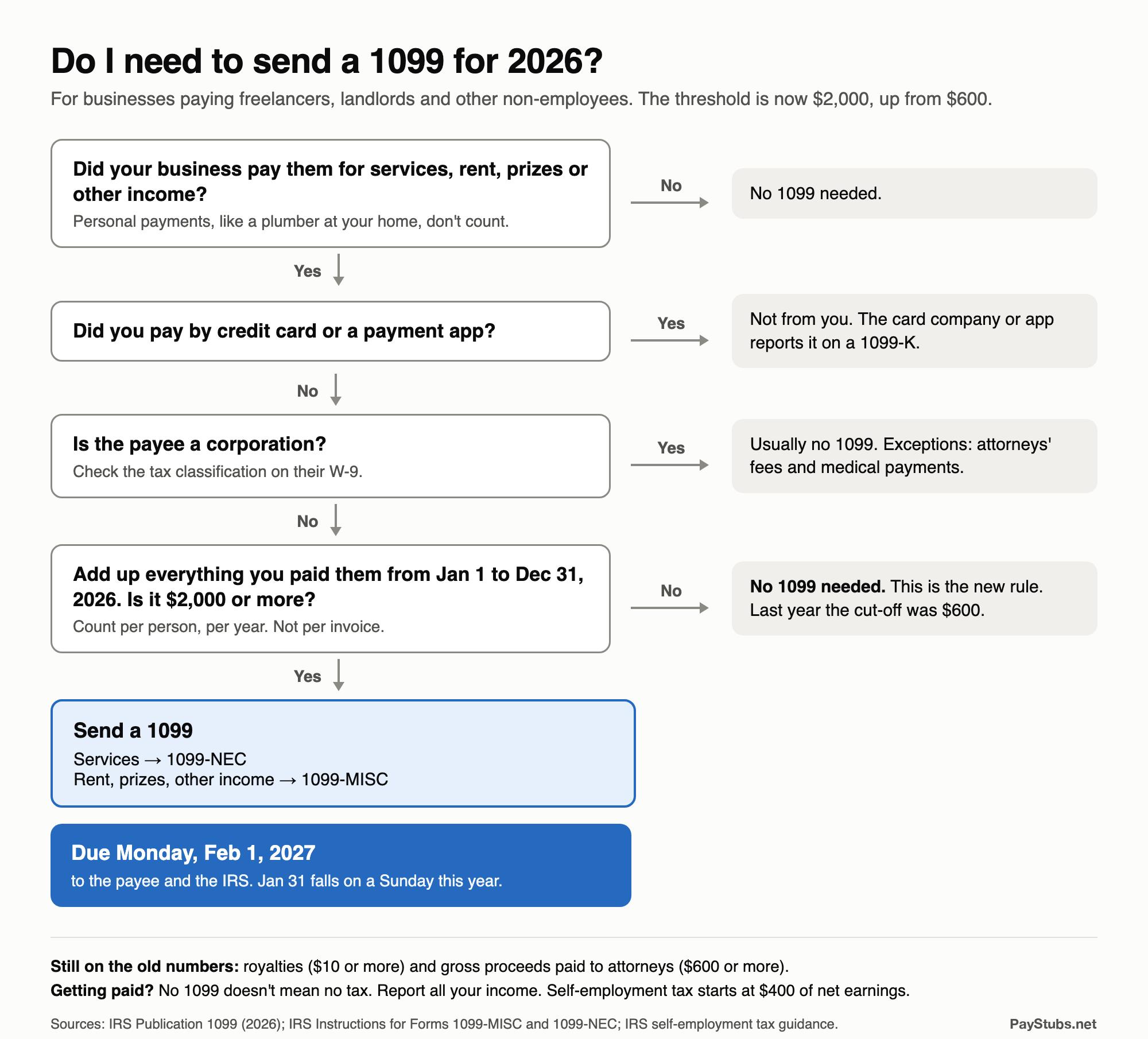
With the 1099 limit rising from $600 to $2,000, PayStubs.net outlines essential compliance steps for businesses and rules for independent contractors.
CA, UNITED STATES, October 30, 2026 /EINPresswire.com/ — Small businesses, property managers, and independent contractors face an evolving regulatory landscape as the Internal Revenue Service (IRS) implements an updated information-reporting threshold. For non-employee payments made throughout calendar year 2026, businesses are only required to issue a Form 1099-NEC or Form 1099-MISC once compensation to a payee reaches or exceeds $2,000 across the year, up from the historical $600 benchmark.
Because informational returns covering 2026 disbursements are due in early 2027, this marks the first filing season executed under the new standard. To assist payors and payees in navigating these changes, online tax document platform PayStubs.net has released a comprehensive compliance guide detailing the decision criteria for issuing 1099s, key operational exemptions, and ongoing tax reporting requirements.
A Decision Framework: Do Businesses Need to Send a 1099 for 2026?
To determine whether an information return is required for a freelancer, landlord, or other non-employee vendor, businesses must evaluate four sequential criteria:
1. Trade or Business Purpose: Payments must occur in the direct course of operating a trade or business. Purely personal expenses, such as hiring a plumber or landscaper for a private residence, do not trigger Form 1099 filing requirements, regardless of the amount paid.
2. Method of Payment: If disbursements are processed via credit card, debit card, or third-party payment apps, reporting responsibilities fall upon the payment processor or card settlement entity via Form 1099-K, rather than the issuing business.
3. Payee Entity Classification: Payments made to incorporated entities generally do not require a Form 1099. Businesses should verify the federal tax classification indicated on the vendor’s Form W-9. Standard exceptions remain for attorney fees and medical/health care payments, which must be reported even if paid to a corporation.
4. Annual Cumulative Spend: Payors must aggregate all disbursements made to a single payee from January 1 through December 31, 2026. The $2,000 threshold applies on a per-person, annual basis; not on individual invoices. Payees receiving less than $2,000 across the entire calendar year do not require a Form 1099 from the business.
Form Selection and the 2027 Deadline
When annual qualifying payments equal or exceed $2,000, businesses must select the appropriate filing instrument:
-Form 1099-NEC: Covers non-employee compensation for independent services, contract labor, and professional fees.
-Form 1099-MISC: Covers commercial rent, non-service prizes, awards, direct medical payments, and other business income.
Form 1099-NEC is normally due to recipients and the IRS on January 31. Because January 31, 2027 falls on a Sunday, forms covering 2026 non-employee payments are officially due on Monday, February 1, 2027.
Thresholds That Remain at Historical Levels
Certain reporting rules remain separate from the new $2,000 threshold:
-Royalties: Must still be reported once payments reach or exceed $10.
-Attorney Gross Proceeds: Reporting on Form 1099-MISC remains mandatory for gross legal proceeds of $600 or more.
“The $2,000 threshold offers meaningful administrative relief for small business owners, but contractors should not mistake a lack of paperwork for a lack of tax liability,” said a spokesperson for PayStubs.net. “Income without a Form 1099 remains taxable. Under federal law, self-employment tax applies once net self-employment earnings reach just $400 for the year.”
Freelancer and Payee Compliance
Independent workers who receive under $2,000 per client may receive zero tax forms, yet they remain legally obligated to report all income. Independent contractors must rely on direct documentation, such as bank statements, invoices, and payment app logs, to prepare accurate returns. In addition, payment platforms only trigger a Form 1099-K when gross sales exceed $20,000 across more than 200 transactions, meaning earnings below that benchmark must still be declared.
According to search trend estimates from Ahrefs, U.S. search volume for “1099 nec” was roughly 20 times higher in January 2026 than in June 2026, highlighting the annual surge in compliance questions as filing deadlines approach.
About PayStubs.net
PayStubs.net provides digital documentation solutions for small businesses, contractors, and human resources professionals. The platform offers more than 35 IRS tax forms, including Forms 1099-NEC, 1099-MISC, and W-9, featuring guided form fields and automatic calculation tools to streamline seasonal filing.
For more information, visit https://www.paystubs.net/ or access tax forms directly at https://www.paystubs.net/tax-forms.
Sources: IRS Publication 1099 (2026); IRS Instructions for Forms 1099-MISC and 1099-NEC; IRS Self-Employment Tax Guidance.
Disclaimer: This announcement is for informational purposes only and does not constitute formal legal, accounting, or tax advice.
Media Relations
PayStubs.net
+1 855-999-7525
support@paystubs.net
Legal Disclaimer:
EIN Presswire provides this news content “as is” without warranty of any kind. We do not accept any responsibility or liability
for the accuracy, content, images, videos, licenses, completeness, legality, or reliability of the information contained in this
article. If you have any complaints or copyright issues related to this article, kindly contact the author above.

Media gallery