
San Francisco, CA – September 04, 2026 – PRESSADVANTAGE –
Schematex today announced the release of an open-source diagram rendering engine that converts plain-text descriptions into professional, standards-compliant diagrams across 52 types spanning medicine, engineering, law, project management, architecture, and risk analysis. The library addresses a critical gap in AI-generated content: while large language models can write code and generate images with ease, they consistently fail at producing technical diagrams that require precise spatial layout, correct symbol placement, and adherence to industry standards.
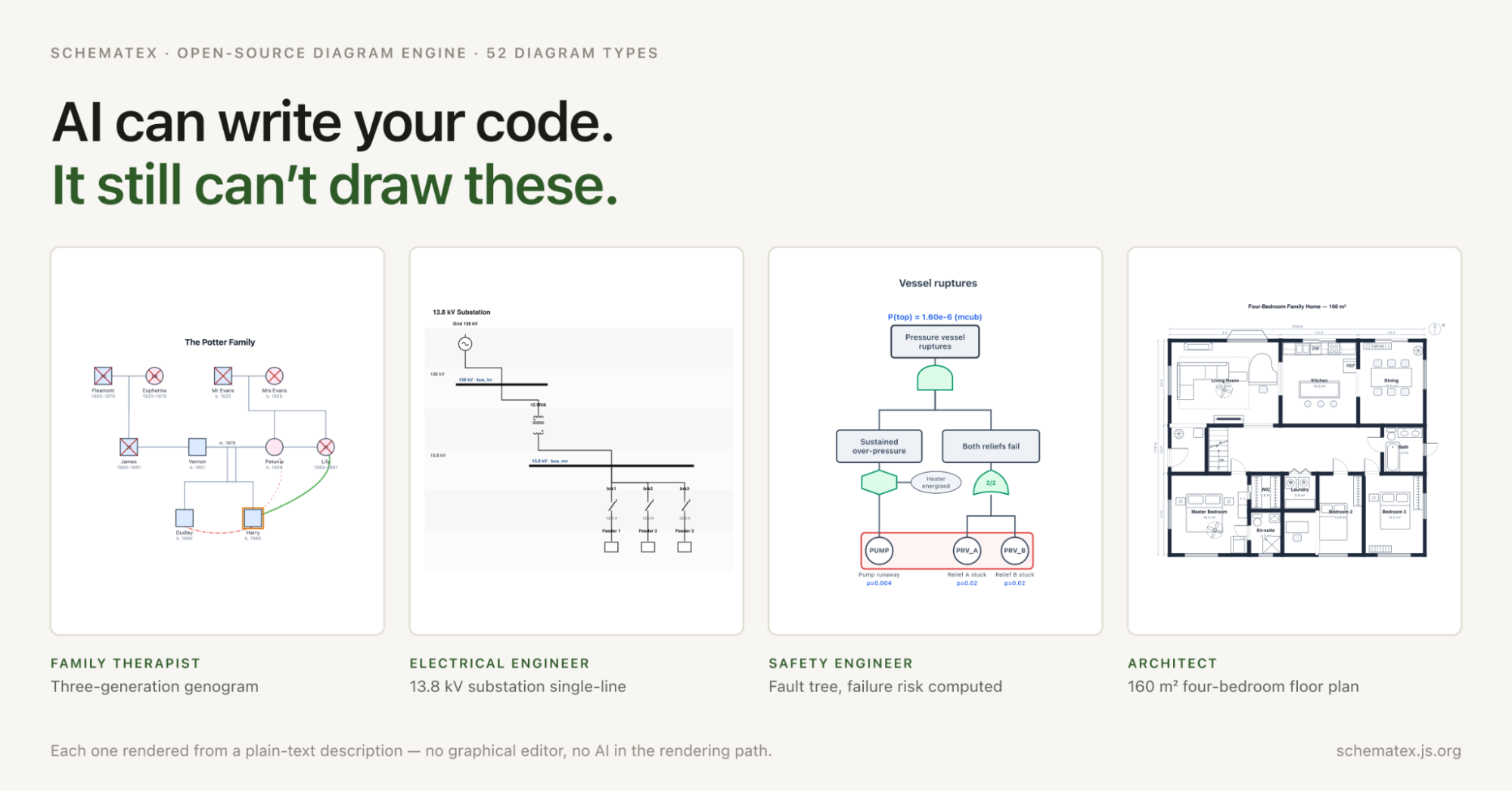
Artificial intelligence in 2026 can write production-grade code, generate photorealistic images, and analyze vast datasets in seconds. But ask it to draw a professional diagram, such as a three-generation genogram for a family therapist or a substation single-line diagram for an electrical engineer, and it fails. The reason is architectural: large language models process language sequentially and lack the spatial reasoning required to place components precisely, route connections without overlap, and maintain proportional relationships across a two-dimensional layout. They can describe what a circuit diagram should contain, but turning that description into a standards-compliant visual with correct symbols and readable labels is a problem no amount of prompt engineering can solve.
The gap is not for lack of trying. Mermaid, the most widely used text-to-diagram tool, handles roughly ten generic types, including flowcharts, sequence diagrams, and basic Gantt charts. For working professionals, these categories barely scratch the surface. A genetic counselor needs pedigree charts following clinical conventions. An electrical engineer needs single-line diagrams drawn to IEEE standards. A safety analyst needs fault trees with computed failure probabilities. Until now, none of these existed as open-source tools. Professionals either drew them by hand in applications like Visio or purchased commercial software licenses costing thousands of dollars per seat.
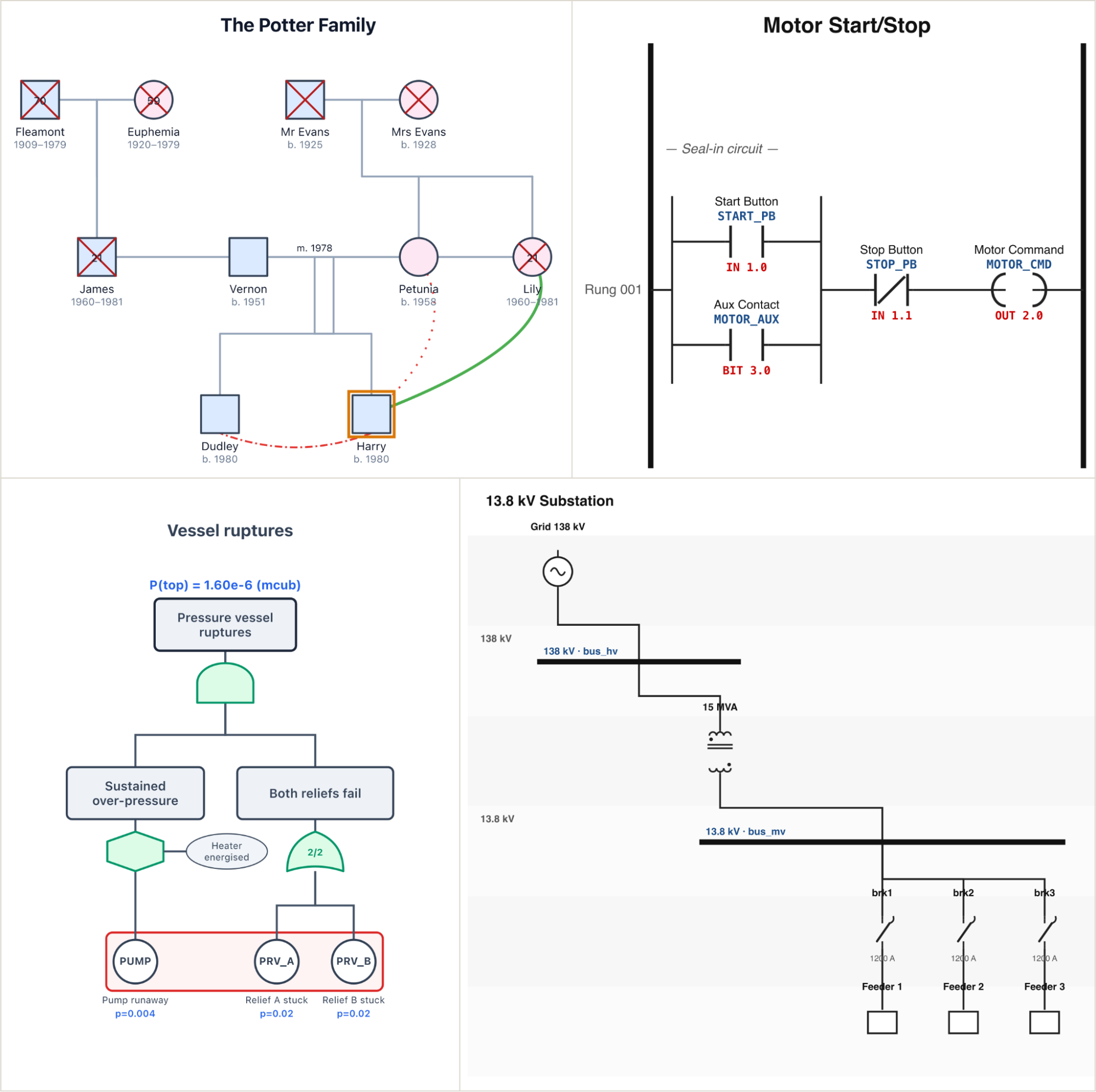
Schematex accepts plain-text descriptions as input and produces standards-compliant SVG diagrams as output. The library currently supports 52 professional diagram types spanning medicine, engineering, law, project management, architecture, and risk analysis, from clinical genograms and industrial ladder logic to PERT project networks with critical path analysis and architectural floor plans with furniture placement.
“The mistake was asking the model to draw,” said Ruinan Zhang, developer of Schematex. “A language model is very good at writing an exact description of a circuit and very bad at deciding where the resistor goes on the page. Schematex splits the job along that line: the model writes, the engine draws.”
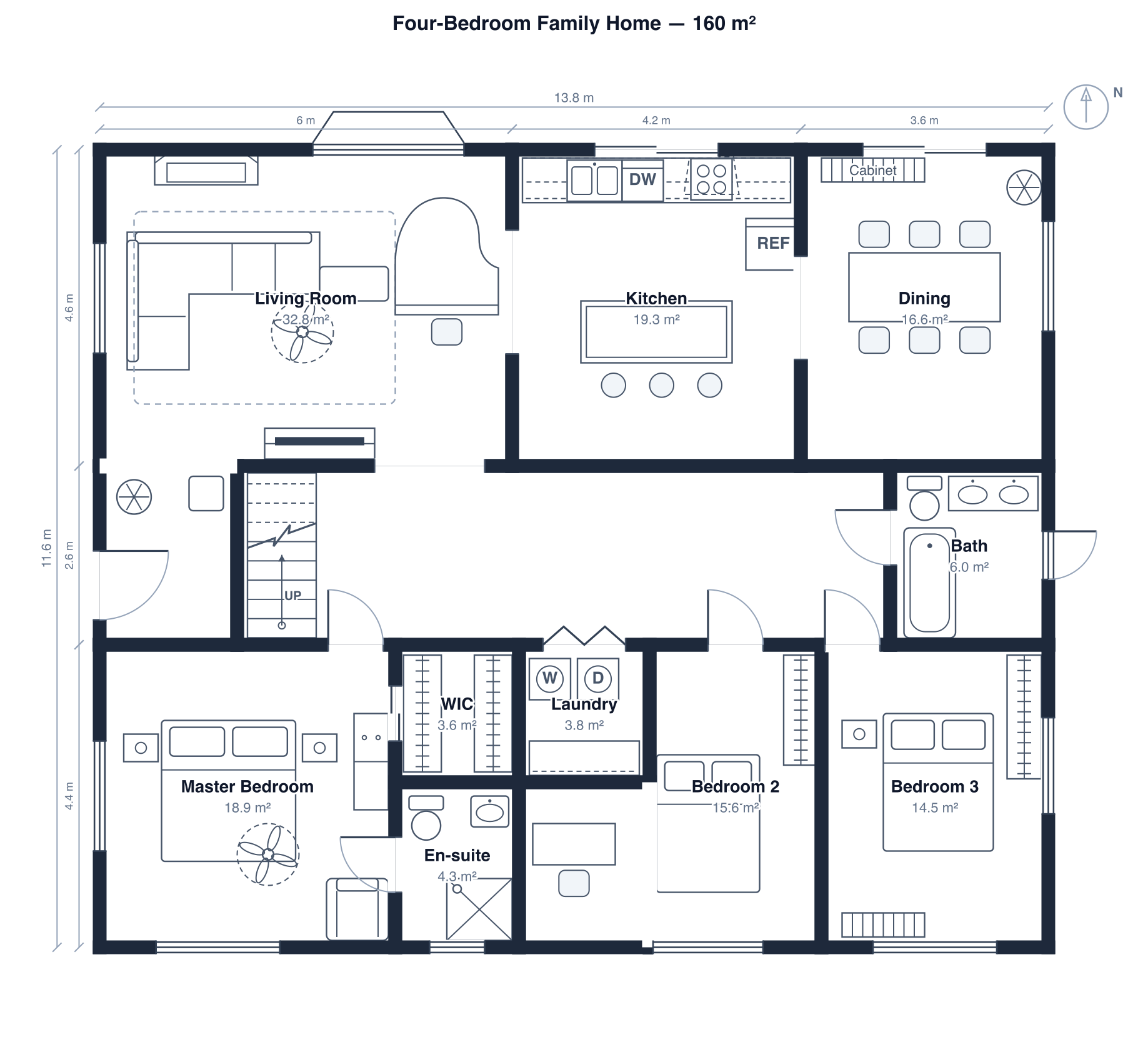
The engine takes a fundamentally different approach from visual diagramming tools. Rather than drag-and-drop editing, each diagram type is described in a domain-specific text grammar tailored to its field. A circuit schematic is written as a netlist. A floor plan specifies rooms with dimensions and furniture placements. This text-based interface is what makes Schematex uniquely suited to AI-powered workflows. A language model generates structured text, the one thing it does reliably, and Schematex handles the spatial layout, symbol selection, and standards compliance that the model cannot.
What further distinguishes Schematex is that it was designed for a world where input comes from AI rather than from a human carefully typing syntax. Its text grammars are shaped by how large language models actually fail, including ambiguous nesting structures, repeated identifiers, encoding issues, and the tendency to hallucinate control characters into output. When parsing fails, error messages tell the AI exactly which line is wrong and how to fix it, enabling self-correction within the generation loop. In production environments, this approach has reduced diagram error rates from roughly 40 per user to approximately 2.
Several of Schematex’s diagram types go beyond rendering to function as full computational engines. Feed it a fault tree and it identifies all minimal cut sets, computes the top-event failure probability, and flags single points of failure. Feed it a PERT chart and it calculates the critical path, earliest and latest start times, and total project duration. These results are calculated and displayed alongside the diagram itself, making the output analytical rather than merely visual.
The engine has already seen production adoption by independent development teams. ChatDiagram, an AI-powered diagram generation platform where users describe what they need in natural language and receive professional-grade output instantly, runs Schematex as its core rendering engine. Over 85 percent of its generated diagrams now flow through the library across more than 47 diagram types. toft.ai, an AI design platform combining freeform canvas editing with generative AI, has integrated Schematex to offer professional diagram capabilities within its design workflow. The library is written entirely in TypeScript with zero runtime dependencies and runs identically in Node.js, edge runtimes, and browsers.
Schematex is available immediately as an open-source project. Developers can install it via npm and integrate it into any JavaScript or TypeScript application. The library ships with comprehensive documentation, examples for all 52 diagram types, and a live playground where any diagram can be tested directly in the browser.
About Schematex:
Schematex is an open-source diagram rendering engine for the diagrams professionals actually use. It supports 52 diagram types across medicine, engineering, law, project management, architecture, and risk analysis, each built to the published international standard for its domain. The library is free, requires zero runtime dependencies, and is designed for integration into AI-powered applications. Learn more at https://schematex.js.org
###
For more information about Schematex, contact the company here:
Schematex
Ruinan Zhang
5106290250
ideamarketfit@gmail.com
San Francisco, CA


