SHANNON, CLARE, IRELAND, July 24, 2026 /EINPresswire.com/ —
Announcing a new publication from Opto-Electronic Advances; DOI 10.29026/oea.2026.250281.
Holography is an advanced optical technique that reconstructs three-dimensional images by recording and reproducing the amplitude, phase, and even polarization state of light waves through the principles of interference and diffraction. With the increasing demand for high-precision light field manipulation and greater information capacity, vectorial holography has emerged as a major research focus in modern optics due to its ability to simultaneously modulate the amplitude, phase, and polarization state of light. In particular, when combined with metasurface technology, which enables subwavelength-scale manipulation of optical fields, vectorial holography gains access to higher-dimensional information encoding and enhanced system integration potential. Compared with conventional scalar holography that only modulates amplitude and phase, vectorial metasurface holography introduces spatially varying polarization control at the nanoscale, offering new approaches for high-capacity data storage, optical encryption, three-dimensional imaging, and immersive display systems. This has made it a rapidly growing area of interest in recent years.
To realize vectorial holography in the true sense, the key lies in achieving full-dimensional control of the optical field, which entails the independent and continuous modulation of amplitude, phase, and arbitrary polarization states. Such capability forms the foundation for constructing arbitrary vectorial light fields and enabling multidimensional information encoding. However, most current implementations of vectorial holography rely on the co-optimization of multiple structural parameters or employ multilayer metasurfaces to introduce sufficient degrees of freedom. While these approaches have demonstrated functional success, they also significantly increase device complexity and fabrication difficulty, and often compromise broadband operation, structural compactness, and system-level integration. Therefore, a major technical challenge in the field is to develop a unified and flexible modulation strategy, capable of independently controlling amplitude, phase, and polarization over a broad spectral range, within a single-layer metasurface platform.
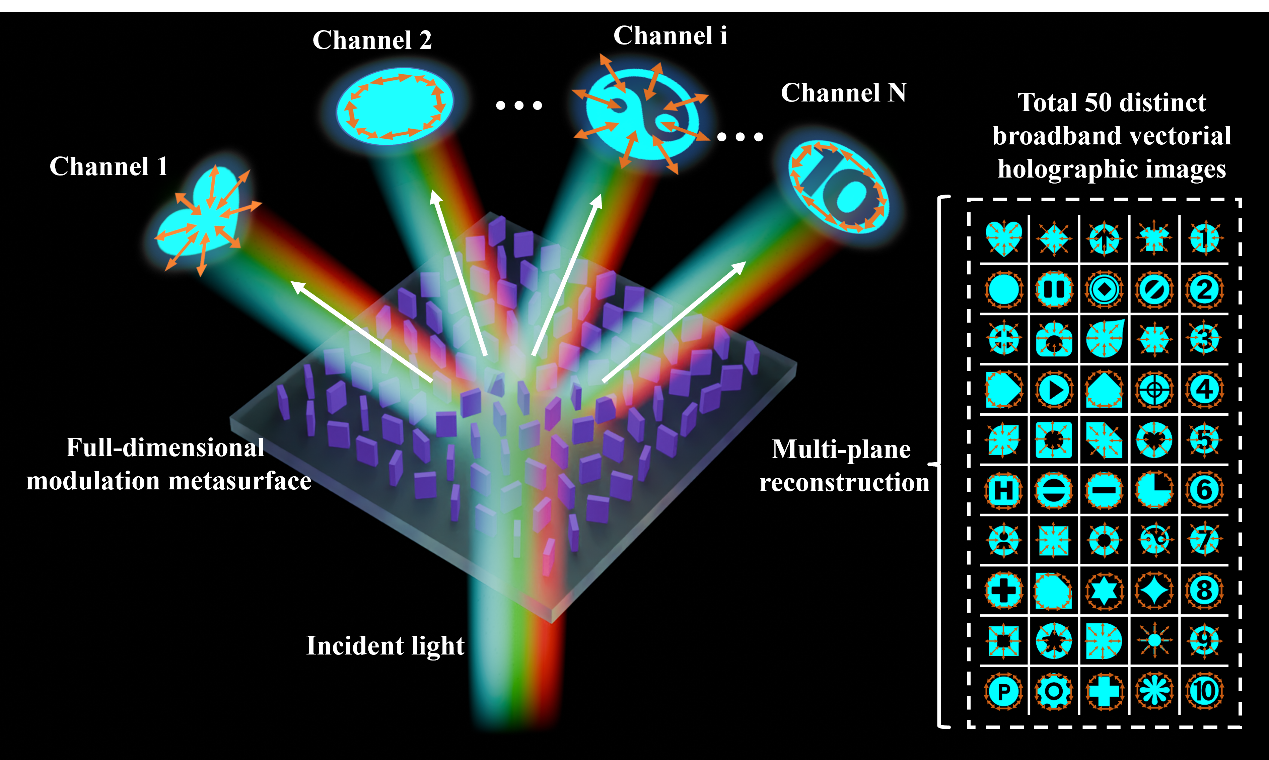
To address this challenge, the research team proposes a broadband full-vectorial metasurface holography scheme based on a purely dielectric geometric-phase metasurface. This approach enables full-dimensional modulation of the optical field—including amplitude, phase, polarization, and spatial position—thereby allowing for the encoding and reconstruction of high-capacity vectorial holographic patterns. In contrast to conventional implementations of vectorial metasurface holography that rely on multilayer architectures or multiple structural parameters to achieve sufficient control, the proposed method achieves complete modulation of the incident light field solely through the rotation angle encoding of individual meta-units (Fig. 1). This significantly simplifies the device design while maintaining high functionality across a broad spectral range.
The research team first demonstrated three distinct vectorial holograms, each featuring spatially tailored polarization characteristics. In these holograms, the upper and lower regions were encoded using customized linear or circular polarization states. Collectively, the reconstructed holograms span the entire Stokes polarization space, thereby confirming the system’s capability for full-vectorial polarization control (Fig. 2).
To further extend the capabilities of vectorial holography, the research team demonstrated that a single metasurface can generate up to 50 distinct vectorial holographic patterns (Fig. 3), each exhibiting spatially varying polarization distributions, such as radial or azimuthal polarization. The study was conducted by the Multi-Dimensional Photonics Laboratory (MDPL) at the Wuhan National Laboratory for Optoelectronics, Huazhong University of Science and Technology (HUST).
Keywords: metasurface, full-dimensional modulation, vectorial holography
# # # # # #
Professor Jian Wang is the Deputy Director of the Wuhan National Laboratory for Optoelectronics. He is a recipient of the National Science Fund for Distinguished Young Scholars of China and has been elected as a Fellow of the IEEE (Institute of Electrical and Electronics Engineers), a Fellow of OPTICA (formerly OSA, The Optical Society), and a Fellow of SPIE (The International Society for Optics and Photonics). He has also been selected for several prestigious national talent programs, including the National Science Fund for Excellent Young Scholars, the Young Changjiang Scholars Program, the National Ten Thousand Talents Program for Top Young Talents, and the Newton Advanced Fellowship of the Royal Society (UK). He currently serves as a member of the Fellow Selection Committee of OPTICA, an executive board member of the Chinese Optical Society (COS), and Vice Chair of the IEEE Photonics Society Wuhan Chapter. He has been listed among the World’s Top 2% Scientists (2019–2023) and recognized as a Highly Cited Researcher in China by Elsevier from 2020 to 2022. As the first contributor, he has received two First Prizes of the Natural Science Award from the Ministry of Education, the Youth Science Award of the Ministry of Education, the First Prize of the Natural Science Award from the Chinese Optical Society, and the Wang Daheng Optics Award for Outstanding Young Scientists.
Jinwei Zeng, Associate Professor and Ph.D. advisor, received his B.S. degree in Optical Information Engineering from Huazhong University of Science and Technology (HUST) in 2007, and his Ph.D. degree from the State University of New York at Buffalo in September 2014. He subsequently worked as a postdoctoral researcher at the Missouri University of Science and Technology (2015–2016) and the University of California, Irvine (2016–2018). In 2019, he joined the Wuhan National Laboratory for Optoelectronics at HUST as an Associate Professor. He was selected for the Hubei Provincial “Hundred Talents Program”. His research focuses on the fundamental physics and applications of structured light–nanostructure interactions, with a particular emphasis on photo-induced force microscopy for super-resolution electromagnetic field characterization. He has published over 20 peer-reviewed SCI papers, with representative first-author works published in internationally renowned journals such as Science Advances, ACS Nano, Nano Letters, and ACS Photonics. He has also authored one invited book chapter as first author, holds one patent, and has been invited to give more than ten presentations at international academic conferences in his field.
Research Group (MDPL):
The Multi-Dimensional Photonics Laboratory (MDPL) at Huazhong University of Science and Technology is dedicated to cutting-edge research in light field manipulation, multidimensional optical communications, optical signal processing, optoelectronic devices and integration, and silicon-based photonic integrated chips. The team targets major national demands and global scientific frontiers in high-speed, large-capacity optical communication and photonic chip integration, and has undertaken multiple key national R&D projects. Their research achievements have been featured as Notable Advances by Optica (formerly OSA) and included in the “13th Five-Year” National Science and Technology Innovation Achievements Exhibition.
# # # # # #
Opto-Electronic Advances (OEA) is a high-impact, open access, peer reviewed SCI journal with an impact factor of 22.4 (Journal Citation Reports 2024). OEA has been indexed in SCI, EI, DOAJ, Scopus, CA and ICI databases, and expanded its Editorial Board to 41 members from 17 countries.
# # # # # #
More information: http://www.oejournal.org/oea
Editorial Board: http://www.oejournal.org/oea/editorialboard/list
All issues available in the online archive (http://www.oejournal.org/oea/archive).
Submissions to OEA may be made using ScholarOne (https://mc03.manuscriptcentral.com/oea).
ISSN: 2096-4579
CN: 51-1781/TN
Contact Us: oea@ioe.ac.cn
Twitter: @OptoElectronAdv (https://twitter.com/OptoElectronAdv?lang=en)
WeChat: OE_Journal
# # # # # #
He DJ, Wan YJ, Dong YJ et al. Ultra-high-capacity full-vectorial meta-holography. Opto-Electron Adv, 250281 (2026). DOI: 10.29026/oea.2026.250281
Opto-Electronic Advances Editorial Office
Opto-Electronic Advances
+86 591 2286 1222
email us here
Legal Disclaimer:
EIN Presswire provides this news content “as is” without warranty of any kind. We do not accept any responsibility or liability
for the accuracy, content, images, videos, licenses, completeness, legality, or reliability of the information contained in this
article. If you have any complaints or copyright issues related to this article, kindly contact the author above.

Media gallery