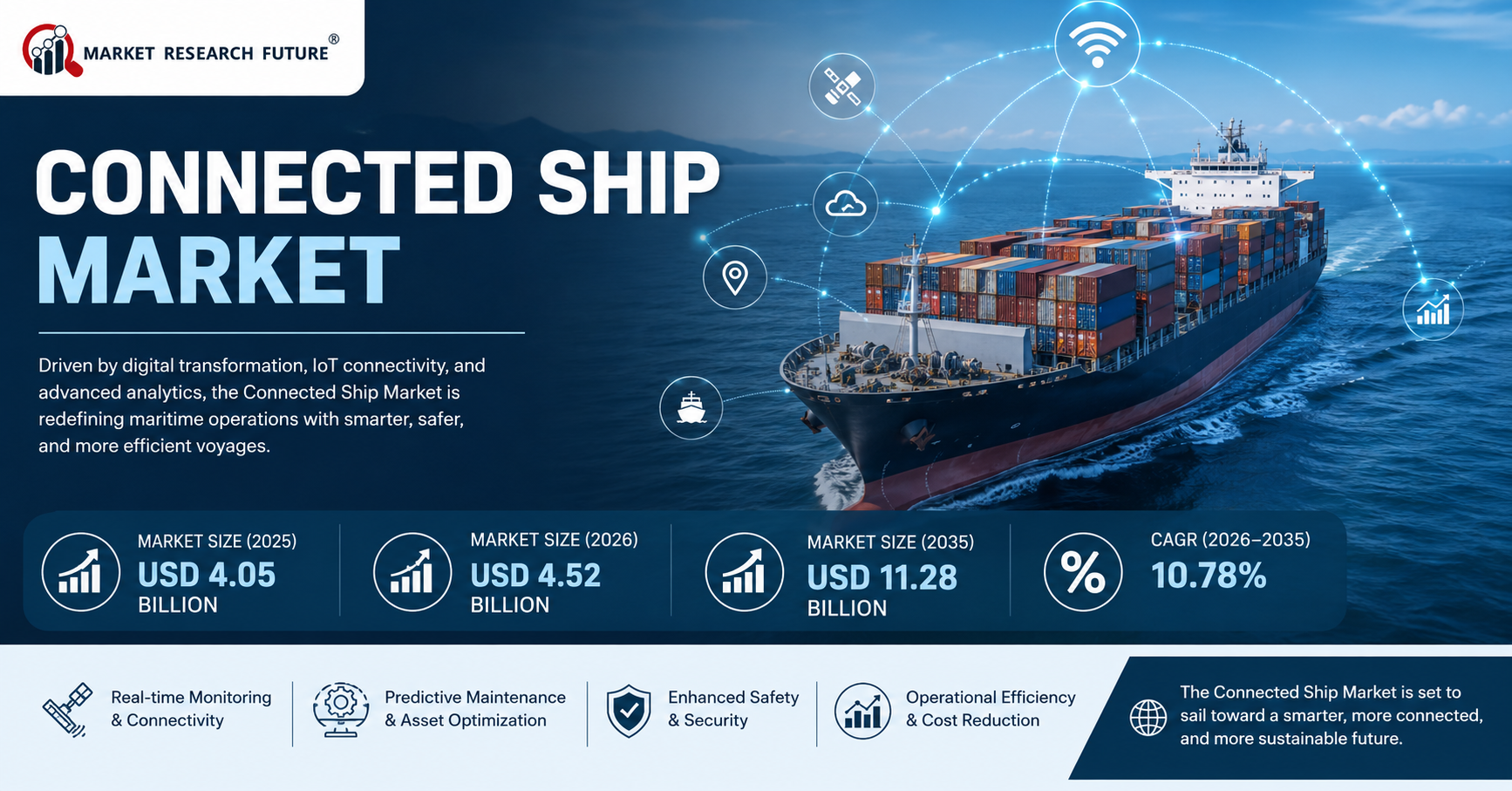
NEW YORK, NY, UNITED STATES, June 26, 2026 /EINPresswire.com/ — The Connected Ship Market is poised for robust expansion as the maritime industry embraces digital transformation, advanced connectivity solutions, and intelligent fleet management technologies. According to the latest industry analysis, the Connected Ship Market was valued at USD 4.05 billion in 2025 and is projected to increase to USD 4.52 billion in 2026. The market is expected to reach USD 11.28 billion by 2035, registering a CAGR of 10.78% during the forecast period (2026–2035).
The growing need for operational efficiency, enhanced vessel safety, predictive maintenance, and real-time communication is driving the rapid adoption of connected ship technologies across commercial and defense fleets. Shipping companies are increasingly investing in integrated digital platforms, satellite communication, cloud computing, Internet of Things (IoT), and artificial intelligence (AI) to improve fleet performance while reducing operating costs and environmental impact.
Market Overview:
Connected ships represent the next generation of maritime transportation, where onboard equipment, navigation systems, engines, cargo management systems, and shore-based control centers operate through an integrated digital ecosystem. These technologies enable continuous monitoring of vessel performance, fuel consumption, weather conditions, cargo status, and maintenance requirements in real time.
The transition toward smart shipping is transforming maritime operations by improving voyage planning, minimizing downtime, strengthening cybersecurity, and enhancing crew safety. Governments and maritime authorities are also encouraging digitalization to improve port efficiency, maritime surveillance, and environmental compliance.
Growing international trade volumes, increasing investment in smart ports, and expanding digital infrastructure continue to create favorable conditions for connected ship technology adoption worldwide.
Request Sample PDF of Report: https://www.marketresearchfuture.com/sample_request/8092
Latest Market Trends:
One of the most significant trends influencing the Connected Ship Market is the increasing deployment of IoT-enabled sensors across vessels. These smart sensors continuously collect operational data from engines, propulsion systems, navigation equipment, and cargo units, allowing shipping operators to make data-driven decisions and improve fleet productivity.
Artificial intelligence is becoming an essential component of connected ship operations. AI-powered analytics help operators optimize fuel usage, predict equipment failures before breakdowns occur, recommend efficient sailing routes, and improve voyage planning. Predictive maintenance solutions are reducing unexpected equipment failures while lowering maintenance expenses.
Another major trend is the growing adoption of cloud-based fleet management platforms. These centralized platforms allow shipping companies to monitor multiple vessels simultaneously from onshore control centers. Fleet managers receive real-time operational insights, enabling faster decision-making and improved coordination across global shipping routes.
Satellite communication technologies continue to evolve rapidly. High-speed broadband connectivity allows uninterrupted communication between ships and shore stations, improving navigation support, crew welfare, cargo tracking, and emergency response capabilities.
The expansion of smart ports is also accelerating connected ship deployment. Modern ports increasingly rely on digital communication with vessels for automated docking, cargo scheduling, traffic management, and logistics optimization, creating seamless coordination between maritime and port operations.
Cybersecurity has become another important market trend as connected vessels generate massive volumes of operational data. Shipping companies are investing in secure communication networks, encrypted data transmission, and cyber risk management solutions to protect critical maritime infrastructure.
Market Drivers:
1. Growing Digital Transformation Across Maritime Industry
Digital transformation remains the primary growth driver for the Connected Ship Market. Shipping operators are replacing conventional systems with integrated digital technologies that provide greater operational visibility, improve navigation accuracy, and reduce manual intervention.
2. Rising Demand for Fleet Optimization
Fleet operators continuously seek ways to reduce operational expenses while maximizing vessel utilization. Connected ship solutions provide real-time performance monitoring, fuel optimization, route planning, and predictive maintenance capabilities that significantly improve fleet efficiency.
3. Increasing Maritime Safety Requirements
Governments and international maritime organizations continue introducing stricter safety regulations. Connected technologies improve collision avoidance, navigation support, weather monitoring, emergency response, and communication between vessels and coastal authorities, strengthening overall maritime safety.
4. Expansion of Smart Ports
Investments in smart port infrastructure are increasing worldwide. Connected ships communicate directly with port management systems, enabling faster berth allocation, cargo handling, customs processing, and vessel scheduling.
5. Growing Adoption in Defense Sector
Defense organizations are modernizing naval fleets through advanced communication systems, intelligent surveillance, autonomous technologies, and secure maritime networks. Connected ship technologies support mission planning, situational awareness, and operational coordination.
Market Opportunities:
The Connected Ship Market presents significant growth opportunities as autonomous shipping technologies continue to mature. Future autonomous and remotely operated vessels will require highly connected digital ecosystems capable of supporting navigation, monitoring, and communication without continuous human intervention.
The integration of digital twin technology represents another promising opportunity. Digital twins enable virtual simulation of vessel operations, allowing operators to evaluate equipment performance, optimize maintenance schedules, and improve operational efficiency before implementing physical changes.
Emerging economies are also investing heavily in port modernization, maritime logistics, and shipping infrastructure. These investments are expected to generate strong demand for connected ship solutions over the coming decade.
Growing emphasis on environmental sustainability creates additional opportunities for solution providers. Connected technologies help shipping companies monitor emissions, optimize fuel consumption, comply with environmental regulations, and reduce carbon footprints.
Segment Analysis:
1. By Ship Type
Based on ship type, the market is segmented into Commercial and Defense.
The Commercial segment accounts for the largest market share owing to increasing deployment of connected technologies across cargo ships, container vessels, tankers, and passenger ships. Commercial operators increasingly rely on connected systems to optimize routes, improve fuel efficiency, monitor cargo, and reduce operating costs.
The Defense segment is projected to witness strong growth throughout the forecast period. Naval organizations continue investing in secure communication networks, advanced surveillance technologies, integrated command systems, and intelligent fleet management to strengthen maritime security.
2. By Installation Type
The market is divided into Onboard and Onshore installations.
The Onboard segment dominates the market due to the growing integration of navigation systems, communication equipment, monitoring sensors, and automation technologies directly within vessels.
The Onshore segment also experiences healthy growth as shipping companies establish centralized fleet operation centers capable of remotely monitoring multiple vessels simultaneously.
3. By Fit
The market includes Line Fit and Retrofit.
Line Fit represents the leading segment because newly constructed ships increasingly incorporate connected technologies during manufacturing, improving system integration while reducing installation costs.
Retrofit demand continues to grow as shipping companies modernize existing fleets with digital communication systems, smart sensors, and intelligent monitoring platforms.
4. By Application
Applications include Fleet Operations, Vessel Traffic Management, and Fleet Health Monitoring.
Fleet Operations holds the largest market share as operators prioritize operational efficiency, route optimization, fuel management, and voyage planning.
Fleet Health Monitoring is expected to record significant growth due to increasing adoption of predictive maintenance solutions that reduce equipment failures and maintenance expenses.
Vessel Traffic Management continues expanding with growing investments in smart ports and intelligent maritime traffic control systems.
Regional Analysis:
Europe – Europe remains a major regional market due to its well-established maritime industry, advanced shipping infrastructure, and early adoption of digital technologies. Regional shipping companies continue investing in automation, fleet optimization, and sustainable shipping solutions.
Asia-Pacific – Asia-Pacific is anticipated to witness the fastest growth during the forecast period. Rapid expansion of commercial shipping, increasing naval modernization programs, large-scale port development, and growing investments by countries such as China and India are supporting market growth.
North America – North America maintains a significant market position owing to technological innovation, strong adoption of digital maritime solutions, and substantial investments in defense modernization and smart shipping initiatives.
Rest of the World – The Rest of the World is gradually adopting connected ship technologies as governments improve maritime infrastructure, expand international trade, and modernize commercial shipping operations.
Competitive Landscape:
Competition within the Connected Ship Market continues to intensify as technology providers introduce advanced digital solutions focused on automation, connectivity, cybersecurity, and predictive analytics. Strategic collaborations, product innovation, software development, and investment in cloud-based maritime platforms remain key competitive strategies.
Key Companies:
Major companies operating in the Connected Ship Market include:
ABB
Emerson Electric Co.
Kongsberg Group
Marlink
Lockheed Martin Corporation
RH Marine
Rockwell Automation, Inc.
General Electric
Schneider Electric
Siemens AG
Viasat, Inc.
Wärtsilä
Intelsat
Inmarsat plc
Hyundai Heavy Industries Co., Ltd.
ABB – ABB is a leading provider of marine automation, electrification, and digital solutions that enhance vessel performance and operational efficiency. Its remote monitoring and integrated control technologies help shipping companies optimize fleet operations and reduce maintenance costs.
Emerson Electric Co. – Emerson Electric Co. delivers advanced automation and industrial control solutions that improve ship reliability and operational safety. Its intelligent monitoring systems enable real-time asset management and predictive maintenance across maritime fleets.
Kongsberg Group – Kongsberg Group specializes in maritime digitalization, navigation, and autonomous vessel technologies. The company offers innovative solutions for smart ship operations, fleet connectivity, and digital twin applications that support efficient vessel management.
Marlink – Marlink is a global provider of satellite communication and digital connectivity services for the maritime industry. Its secure communication solutions enable uninterrupted ship-to-shore connectivity, remote monitoring, and advanced IoT applications.
Lockheed Martin Corporation – Lockheed Martin Corporation develops advanced maritime defense technologies, secure communication systems, and mission-critical naval solutions. Its connected ship capabilities enhance situational awareness, surveillance, and operational coordination for defense fleets.
RH Marine – RH Marine provides integrated automation, electrical, and navigation systems designed for commercial and naval vessels. The company’s smart ship technologies improve onboard efficiency, safety, and overall vessel performance.
Rockwell Automation, Inc. – Rockwell Automation, Inc. delivers industrial automation and digital transformation solutions that help optimize shipboard operations. Its connected technologies support predictive maintenance, process automation, and improved operational visibility.
General Electric – General Electric offers advanced marine power systems and digital industrial technologies that strengthen vessel performance and reliability. Its data-driven solutions enable shipping operators to maximize equipment efficiency while minimizing downtime.
Schneider Electric – Schneider Electric develops energy management and automation solutions that improve the sustainability and efficiency of connected ships. Its digital platforms support intelligent power distribution, remote asset monitoring, and operational optimization.
Siemens AG – Siemens AG provides cutting-edge marine automation, electrification, and digitalization technologies for modern vessels. The company’s integrated solutions enhance energy efficiency, vessel control, and smart fleet management capabilities.
Recent Developments:
September 2024: Starlink Maritime surpassed 15,000 active vessel terminals worldwide, marking a significant milestone in maritime connectivity. Following this achievement, the company reduced pricing for its maritime IoT connectivity packages by 20%, making advanced connected ship solutions more accessible for mid-sized commercial fleet operators.
June 2024: Kongsberg Digital entered into a strategic partnership with DNV to incorporate Vessel Insight digital twin data into class survey processes. The collaboration enables more data-driven vessel inspections and has the potential to reduce the need for physical surveys by approximately 40%, improving operational efficiency and lowering maintenance costs.
January 2024: The European Parliament expanded the EU Emissions Trading System (EU ETS) to include maritime transport. This regulatory change has accelerated the adoption of continuous emissions monitoring technologies, increasing the importance of maritime IoT connectivity platforms for vessels operating within EU trade routes.
August 2023: ABB Marine & Ports strengthened its global remote service capabilities by establishing 24/7 remote diagnostic centers in Singapore and Houston. These facilities provide continuous monitoring and technical support for more than 1,200 ABB-equipped vessels, helping ship operators enhance reliability, minimize downtime, and improve fleet performance.
Conclusion:
The Connected Ship Market is entering a new phase of growth driven by digital transformation, intelligent fleet management, AI-powered analytics, satellite communication, and increasing maritime automation. As global shipping companies focus on operational efficiency, environmental sustainability, and enhanced maritime safety, connected ship technologies will become fundamental to future fleet operations.
Browse More Reports:
Connected Aircraft Market
https://www.marketresearchfuture.com/reports/connected-aircraft-market-6039
Aircraft Carrier Ship Market
https://www.marketresearchfuture.com/reports/aircraft-carrier-ship-market-25041
Digital Shipyard Market
https://www.marketresearchfuture.com/reports/digital-shipyard-market-9632
Electric Ships Market
https://www.marketresearchfuture.com/reports/electric-ships-market-8674
Sagar Kadam
Market Research Future
+ +1 628-258-0071
email us here
Visit us on social media:
LinkedIn
Facebook
YouTube
X
Legal Disclaimer:
EIN Presswire provides this news content “as is” without warranty of any kind. We do not accept any responsibility or liability
for the accuracy, content, images, videos, licenses, completeness, legality, or reliability of the information contained in this
article. If you have any complaints or copyright issues related to this article, kindly contact the author above.

Media gallery