Every Vadzo OEM camera can be customized to include secure boot and hardware root of trust at the silicon level, paired with a cloud-based failsafe OTA update platform that manages, monitors, and maintains Linux-based camera fleets remotely without physical device access.
FORT WORTH, TX / ACCESS Newswire / June 4, 2026 / Vadzo Imaging today announced the extension of secure boot, firmware signing, hardware root of trust, and failsafe encrypted OTA update capabilities across its OEM embedded camera portfolio, alongside integration with a cloud-based remote device management platform that enables Linux-based camera fleets to be updated, configured, monitored, and maintained entirely over the air, without physical access to deployed devices.
An embedded camera without a verified boot chain is an open entry point in any connected deployment. A camera that accepts unverified firmware updates is a persistent attack surface across its entire operational lifetime. For OEMs shipping camera modules into smart city infrastructure, clinical networks, perimeter security installations, and industrial automation platforms, these are not theoretical risks but they are the failure modes that appear in post-incident security audits and compliance reviews. Vadzo addresses them at two levels: hardware enforcement at the device, and verified fleet management in the cloud.
Security customization is available across the full Vadzo OEM camera portfolio. OEMs can request secure boot and hardware root of trust integration as part of the standard customization program which is a hardware-level modification provisioned at manufacture, not a software policy applied after deployment. Any Vadzo camera platform, across USB, MIPI, GigE, and SerDes interfaces, can be configured with a cryptographic identity that persists from first boot to end of life.
The three hardware security layers
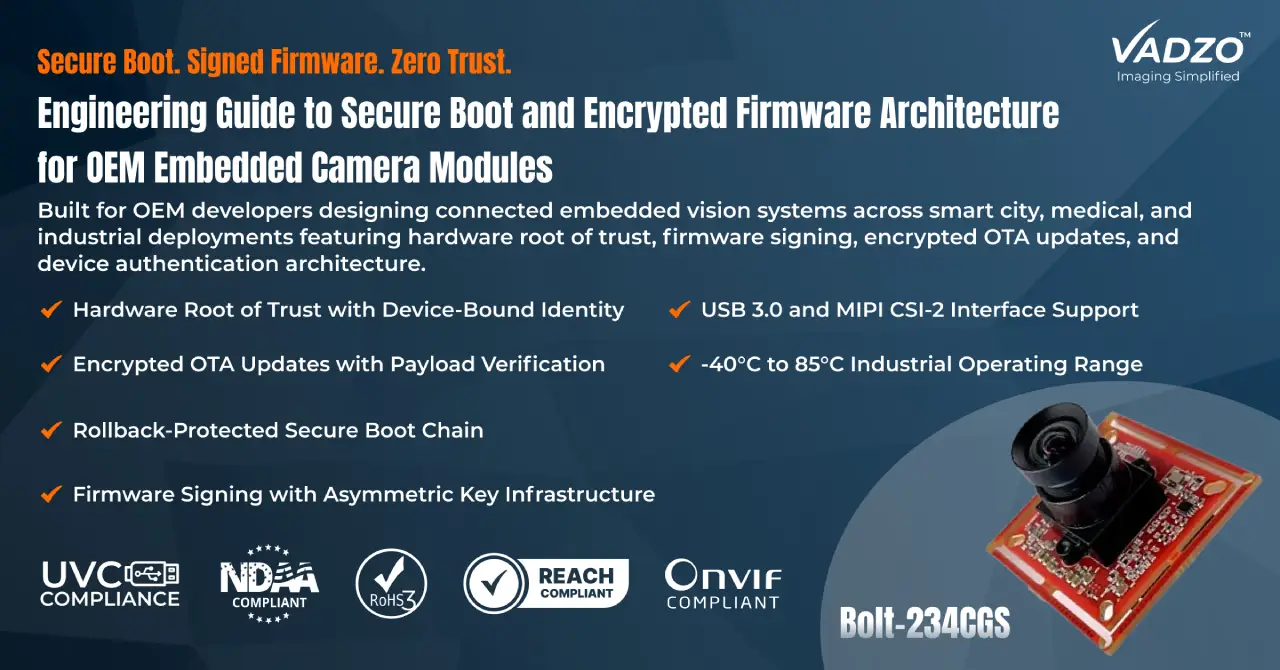
Secure boot & hardware root of trust: At power-on, the bootloader validates the firmware signature against a hardware root of trust provisioned at the silicon level. If the signature does not match, whether from tampering, corruption, or an unauthorized image, the device does not boot. No unverified code executes. This is not a software policy. It is hardware enforcement that cannot be overridden from the application layer. The integrity of every imaging output begins here: a camera that cannot verify what it is running cannot guarantee what it is producing.
Firmware signing & device authentication: Every firmware image is signed with a private key held by the manufacturer. The camera module verifies the signature against the corresponding public key before applying any update, ensuring every update originated from a verified source and has not been modified in transit. Device authentication extends this to network identity: the device presenting itself on the network is the device it claims to be, with the firmware state it claims to be running. Together these define the identity layer that regulated network admission requires.
Firmware encryption: Firmware images are encrypted such that a physically extracted image cannot be reverse-engineered, cloned, or loaded onto a different device. The cryptographic binding between firmware and hardware identity means the firmware is inoperable outside the device it was provisioned for. For OEMs shipping into regulated environments or building proprietary vision algorithms into camera firmware, this protects both network security and intellectual property simultaneously.
Failsafe remote fleet management – the cloud layer
Hardware security at the device is necessary but not sufficient for connected camera deployments at scale. A fleet of 300 cameras across a hospital network, a city’s traffic infrastructure, or a distributed industrial inspection system requires a management layer that can verify every device’s firmware state, push verified updates without physical access, and recover devices that fail mid-update, without dispatching a technician to each node.
Vadzo’s embedded camera portfolio integrates with a cloud-based IoT device management platform purpose-built for Linux-based device fleets. The platform operates on a discover, release, deploy, monitor, and maintain cycle, providing OEMs and fleet operators a single dashboard for the complete firmware lifecycle of every camera in their deployment.
Failsafe update architecture: every firmware deployment includes failsafe modules that detect mid-update failures and roll back to the last verified state automatically, without manual intervention. A device that loses power or connectivity during an update does not become a brick. It recovers to its last known-good firmware version and re-attempts the update on the next cycle. At fleet scale, this eliminates the single most common cause of camera downtime in remote deployments.
Remote fleet management – four operational pillars
The platform manages Linux-based camera fleets across all four phases of the device lifecycle, from first deployment through every firmware revision to end of life, without requiring physical access to any device in the fleet.
Update: Discover devices requiring updates using filters. Manage firmware releases and artifacts. Schedule deployments with advanced failsafe modules. Each update is signed, encrypted, and verified before installation – the camera applies only updates it can independently confirm.
Configure: Adjust and control camera peripherals and parameters across the entire fleet from a single interface. Apply configurations per-device or fleet-wide, even across devices running different firmware versions. User access control restricts configuration rights to authorized operators.
Monitor: Continuous 24/7 health and performance monitoring with smart edge processing that adapts to unstable connectivity, critical data reaches the dashboard even when camera network links are intermittent. Instant customizable alerts with detailed log collection minimize resolution time.
Maintain: Real-time remote troubleshooting via secure terminal sessions, log file access, and SSH for each device. File transfer and port forwarding support in-depth diagnosis without physical access. Role-based access ensures maintenance operations are authorised and auditable.
Secure camera portfolio
The following three camera configurations represent production-ready secure deployments across the Vadzo portfolio. Secure boot, hardware root of trust, and encrypted OTA support are available as customization options across the full Vadzo camera range, not limited to these three platforms.
AR0234 Color Global Shutter MIPI Camera: 2MP Secure Imaging for Traffic and Edge AI
The AR0234 Color Global Shutter MIPI Camera targets traffic monitoring nodes, edge AI platforms, and smart city infrastructure, where embedded device security and motion accuracy are both non-negotiable. Delivering 2MP output at 1920×1200 on the onsemi AR0234 BSI CMOS with global shutter readout and hardware trigger support, it produces geometrically accurate frames with a verified firmware chain at every boot cycle. This 2MP Global Shutter HD MIPI Camera operates over MIPI CSI-2 with UVC-compliant output, making it a production-ready module for secure edge deployments requiring no proprietary driver integration.
Key specs: 2MP (1920×1200) | Onsemi AR0234 | Global Shutter | 1/2.6″ BSI CMOS | MIPI CSI-2 | Secure Boot | Hardware Trigger
AR0521 Color 5MP USB 3 Camera: Low Noise Surveillance for Perimeter Security
The AR0521 Color 5MP USB 3 Camera targets perimeter security, industrial inspection, and outdoor surveillance deployments where high resolution and cybersecurity for IoT compliance are both required at the network edge. Delivering 5MP output at up to 30fps on the onsemi AR0521 BSI CMOS with low noise architecture, it maintains clean signal quality across illuminance variation while operating under a signed firmware chain. This 5MP Rolling Shutter surveillance USB 3 camera operates over USB 3.0 with UVC-compliant plug-and-play output for direct integration with standard VMS and NVR platforms.
Key specs: 5MP (2592×1944) | Onsemi AR0521 | Rolling Shutter | 1/2.5″ BSI CMOS | USB 3.0 / UVC | Low Noise | Secure Firmware Update
IMX662 2MP Color 1080P HDR Gigabit Ethernet Camera: High SNR for Clinical and Low-Light Networks
Clinical monitoring and patient safety networks require device identity verification at the firmware level before any camera module is permitted to transmit on the clinical infrastructure, a compliance requirement that applies equally to imaging devices and network equipment. The IMX662 2MP Color 1080P HDR Gigabit Ethernet Camera, upon customization, operates under a hardware root of trust architecture with encrypted OTA updates, meeting the identity requirements of regulated medical and institutional network environments. Sony IMX662 STARVIS 2 delivers high-SNR HDR output under the active IR illumination used in clinical low-light monitoring, with Gigabit Ethernet PoE simplifying cable infrastructure across large hospital deployments.
Key specs: 2MP (1920×1080) | Sony IMX662 STARVIS 2 | Rolling Shutter | 1/2.8″ BSI CMOS | USB 2.0 / UVC | HDR + High SNR | Encrypted OTA
“Most connected deployments fail a security audit not because they were attacked, but because they cannot prove they were not. The real question is not whether the network is secure. It is whether every device on that network can independently verify what it is running and reject anything it cannot confirm. A camera that depends on the network to enforce its own integrity is a liability. Verified boot, signed firmware, and failsafe fleet updates are not features to be procured separately, they are conditions we build in from the first boot cycle.” – Alwin Vincent, Product Manager, Vadzo Imaging
Frequently Asked Questions (FAQs)
What is hardware root of trust in an embedded camera and why is it more secure than a software security policy?
Hardware root of trust in an embedded camera is a cryptographic identity provisioned at the silicon level during manufacture, it cannot be modified, overwritten, or bypassed by software, firmware, or an attacker with physical access to the device. It is the anchor point from which all other security guarantees such as secure boot, firmware signing, encrypted updates derive their validity. A software security policy depends on the software layer being intact to enforce it. If an attacker can modify the firmware before the policy runs, the policy never runs. Hardware root of trust moves the verification anchor below the software layer into the hardware itself, the bootloader checks the firmware signature against a key stored in hardware-protected memory before executing a single line of application code. On Vadzo OEM camera platforms, this means an attacker who physically extracts the device’s storage and replaces the firmware with a modified image will find the device refuses to boot it. The camera independently enforces its own integrity without relying on the network, the host, or any external system.
Can secure boot and hardware root of trust be added to any Vadzo camera, or only specific models?
Secure boot and hardware root of trust are available as OEM customization options across Vadzo’s full embedded camera portfolio, including USB, MIPI, GigE, and SerDes platforms, provisioned at the hardware level during the OEM manufacturing process, not added as a software feature post-deployment. The AR0234 MIPI camera, AR0521 USB 3.0 camera, and Innova-662CRS Gigabit Ethernet configurations highlighted in this release represent production-ready secure deployments, but the customization program extends to the full Vadzo portfolio. OEMs requesting secure boot integration as part of their camera customization program receive devices provisioned with a cryptographic identity at manufacture, the key material is burned into hardware-protected storage and the bootloader is configured to enforce signature verification before any firmware executes. Lead times and technical requirements for secure boot customization are discussed with Vadzo’s applications engineering team at the time of OEM program initiation.
What happens if a camera fails mid-update during a remote firmware deployment?
Vadzo’s integrated remote fleet management platform includes failsafe modules that automatically detect a failed or interrupted firmware update and roll back the device to its last verified firmware state without manual intervention, preventing bricked devices across large remote deployments. A mid-update failure without failsafe protection leaves the device in a partial state: the old firmware has been partially overwritten, the new firmware is incomplete, and the device cannot boot either. In a remote deployment this requires a physical site visit to recover. The failsafe update architecture maintains a verified backup partition. If the update process is interrupted at any point, the device reboots into the backup, confirms its integrity against the hardware root of trust, and reports the failure to the management dashboard. The fleet operator sees the failed device flagged in the monitor view and can reschedule the update without dispatching field staff.
How does the remote fleet management platform integrate with existing Linux-based camera deployments?
The remote fleet management platform integrates with any Linux-based device fleet through a lightweight client agent installed on each camera’s host system, it is 100% API-driven, compatible with standard CI/CD pipelines, and operates over HTTPS polling, requiring no proprietary network infrastructure or dedicated update servers. The client agent runs on the Linux operating system of the camera host, whether that is a Jetson companion computer, a Raspberry Pi, a custom embedded Linux board, or a standard x86 host. It periodically polls the management server for pending updates, downloads signed and encrypted firmware packages over HTTPS, verifies the payload before installation, and reports status back to the dashboard. From the fleet operator’s perspective, devices appear in the dashboard within minutes of client installation. Updates are deployed through a release management workflow such as upload the signed firmware, create a deployment targeting specific device groups, and monitor rollout status in real time. No VPN, no proprietary protocols, no on-premise update server required.
What happens to firmware security when a Vadzo OEM camera is decommissioned or resold?
Firmware on a secure-boot-enabled Vadzo camera is cryptographically bound to the hardware identity provisioned at manufacture, an extracted firmware image is inoperable on any other device, and device credentials and trust state do not transfer with the hardware when it is decommissioned or resold. The hardware root of trust creates a unique cryptographic binding between the firmware and the specific silicon it was provisioned for. Even if an attacker physically extracts the firmware storage and copies its contents to an identical camera module, the hardware identity check at boot fails, the firmware cannot execute because the hardware key it was signed against does not exist in the new device. For OEMs building proprietary vision algorithms or ISP tuning parameters into camera firmware, this means their intellectual property is protected at hardware level across the device’s entire lifecycle, including after decommissioning.
Does secure boot affect frame rate, latency, or platform integration on Jetson or Raspberry Pi?
Secure boot verification completes entirely within the bootloader phase before the imaging pipeline initializes, frame rate, streaming latency, and MIPI CSI-2, USB, or GigE interface behaviour are completely unaffected, and integration follows standard UVC, V4L2, and GStreamer workflows on NVIDIA Jetson, Raspberry Pi, and i.MX platforms. The signature verification step adds a small amount of time to the boot sequence, typically under one second, before the operating system and imaging pipeline initialize. Once the device is running, secure boot has zero runtime overhead: it is a one-time check at power-on, not a continuous monitoring process. All downstream integration such as USB UVC enumeration, MIPI CSI-2 lane negotiation, GigE device discovery, V4L2 device nodes, ROS2 camera topics proceeds identically to a non-secure configuration. The VISPA ARC SDK and VISPA NXT SDK APIs for streaming, ROI, GPIO, and parameter control are fully available on secure-boot-enabled camera configurations.
Availability
The AR0234 Color Global Shutter MIPI Camera, 5MP Rolling Shutter surveillance USB 3 camera, and IMX662 2MP Color 1080P HDR Gigabit Ethernet Camera are available now for OEM evaluation and production deployment. Technical documentation, evaluation kits, datasheets, and SDK downloads are available through the Vadzo Imaging sales team. For volume pricing, OEM customization, and firmware modifications, contact support@vadzoimaging.com.
About Vadzo Imaging
Vadzo Imaging is one of the few companies worldwide that designs and manufactures embedded vision systems and camera modules from India, delivering premium imaging products at accessible prices for OEMs and system integrators worldwide. The company builds imaging platforms across USB, MIPI, GigE, Wi-Fi, and SerDes interfaces, supporting applications in industrial automation, robotics, smart surveillance, smart city infrastructure, and edge AI. Every product is built on the principle that world-class imaging performance, designed and manufactured in India, should be accessible, reliable, and instantly deployable anywhere in the world. Visit vadzoimaging.com to explore the full camera portfolio.
Media Contact
Alwin Vincent
Vadzo Imaging
Email: alwin@vadzoimaging.com
LinkedIn: Vadzo Imaging
YouTube: Vadzo Imaging
X: Vadzo Imaging
SOURCE: Vadzo Imaging
View the original press release on ACCESS Newswire


