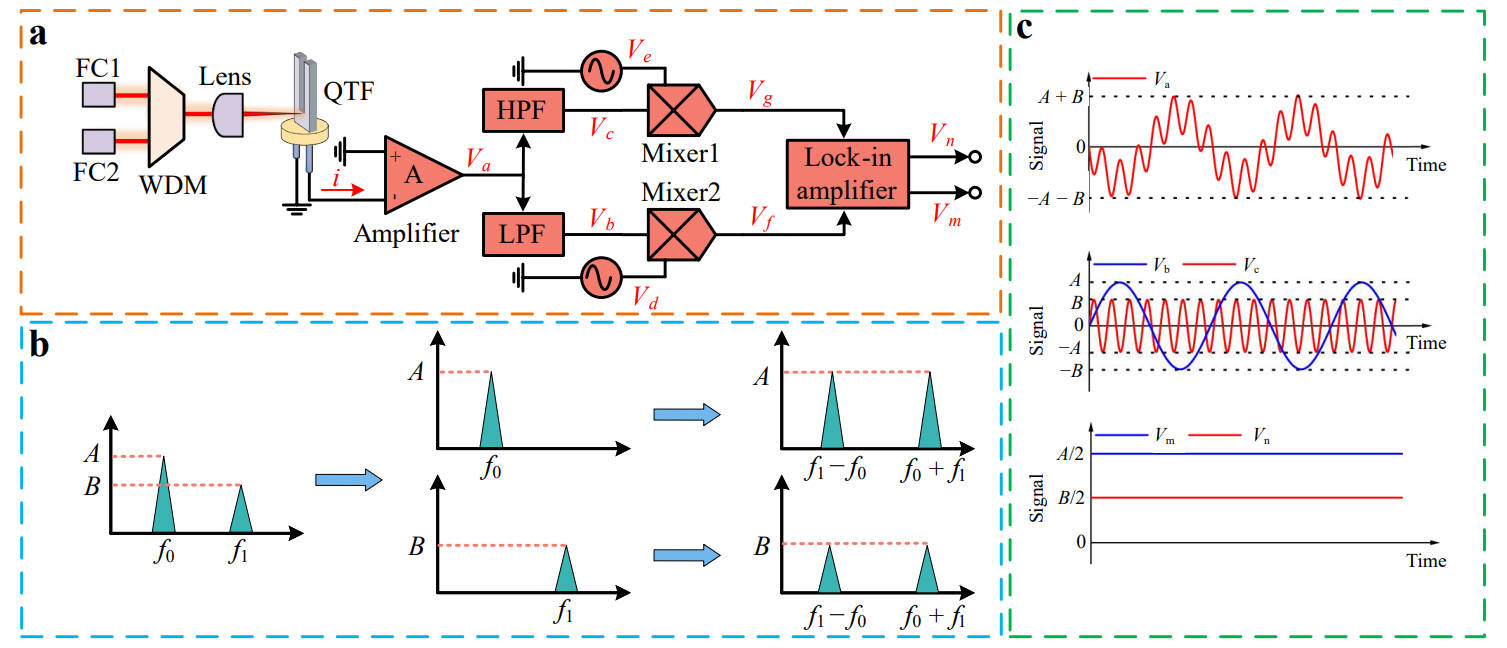
GA, UNITED STATES, May 22, 2026 /EINPresswire.com/ — A Harbin Institute of Technology team proposes a mixed-frequency heterodyne demodulation architecture for dual-gas LITES sensing using a single quartz tuning fork. The sensor achieves low-crosstalk simultaneous detection of methane and acetylene, simplifying system design for cost-effective industrial safety and environmental monitoring.
Gas sensing technology is a cornerstone of industrial safety, environmental monitoring, and public health, enabling early detection of hazardous gas leaks and precise tracking of pollutant emissions. With the rapid development of industrial automation and increasingly stringent environmental regulations, there is a growing demand for compact, low-cost multi-gas detection systems that can perform real-time simultaneous measurements.
Light-induced thermoelastic spectroscopy (LITES) has emerged as a promising trace gas detection technique due to its high sensitivity, excellent selectivity, and non-contact measurement capability. Unlike conventional quartz-enhanced photoacoustic spectroscopy, LITES detects the periodic photothermal signal generated by gas molecules absorbing modulated laser light, making it suitable for harsh environments such as corrosive atmospheres and high-temperature flames. However, existing multi-gas LITES systems rely on either time-division multiplexing, which cannot achieve true simultaneous detection, or conventional frequency-division multiplexing, which requires independent demodulation units for each channel, leading to increased system complexity, cost, and inter-channel crosstalk.
In a new paper published in Light: Advanced Manufacturing, a team led by Professor Yufei Ma from the National Key Laboratory of Laser Spatial Information at Harbin Institute of Technology, China, has developed a novel mixed-frequency heterodyne demodulation (MHD) architecture that addresses these limitations. Using this architecture, the team constructed a dual-gas LITES sensor based on a single quartz tuning fork (QTF), achieving simultaneous low-crosstalk detection of methane and acetylene.
The core innovation of this work lies in the mixed-frequency heterodyne demodulation scheme, which converts photothermal signals of different frequencies to a common intermediate frequency carrier. This eliminates the need for multiple high-frequency reference sources, reducing system synchronization complexity and hardware costs significantly. The sensor leverages both the fundamental and first overtone vibration modes of a single custom-designed frequency QTF to detect two gas species simultaneously.
To minimize inter-channel crosstalk, the system incorporates a three-stage frequency-domain isolation mechanism consisting of fourth-order Butterworth filters, frequency mixing circuits, and narrowband lock-in amplification. Comprehensive performance tests demonstrate that the inter-channel crosstalk is suppressed to below 0.057%. Both channels exhibit excellent linearity with concentration correlation coefficients R2 > 0.999, maximum nonlinear errors of 1.39% and 1.48% full scale, and average relative system errors of 0.95% and 0.93% for methane and acetylene, respectively. With an integration time of 300 seconds, the sensor achieves minimum detection limits of 0.13 ppm for methane and 2.93 ppm for acetylene.
“This architecture simplifies the multi-gas LITES system dramatically while maintaining excellent detection performance,” said Professor Ma. “It provides a new technical path for the development of integrated, low-cost multi-gas sensors.”
Looking forward, the team plans to further integrate the demodulation technology into a dedicated application-specific integrated circuit (ASIC) to achieve miniaturized and portable sensor systems. They will also expand the detection capability to three or more gas species by utilizing higher-order vibration modes of the QTF and additional laser wavelengths. Field tests in industrial and environmental scenarios will be conducted to validate the practical performance of the technology, promoting its widespread application in natural gas pipeline monitoring, chemical plant safety, and atmospheric environmental protection.
Original Source URL
https://doi.org/10.37188/lam.2026.054
Funding information
This work was supported by the National Natural Science Foundation of China (Grant Nos. 62335006, 62275065, 62505066, 62022032, and 62405078), the Heilongjiang Postdoctoral Fund (Grant No. LBH-Z23144 and LBH-Z24155), the Natural Science Foundation of Heilongjiang Province (Grant No. LH2024F031), China Postdoctoral Science Foundation (Grant No. 2024M764172), and Open Subject of Hebei Key Laboratory of Advanced Laser Technology and Equipment (HBKL-ALTE2025001).
Lucy Wang
BioDesign Research
email us here
Legal Disclaimer:
EIN Presswire provides this news content “as is” without warranty of any kind. We do not accept any responsibility or liability
for the accuracy, content, images, videos, licenses, completeness, legality, or reliability of the information contained in this
article. If you have any complaints or copyright issues related to this article, kindly contact the author above.

Media gallery