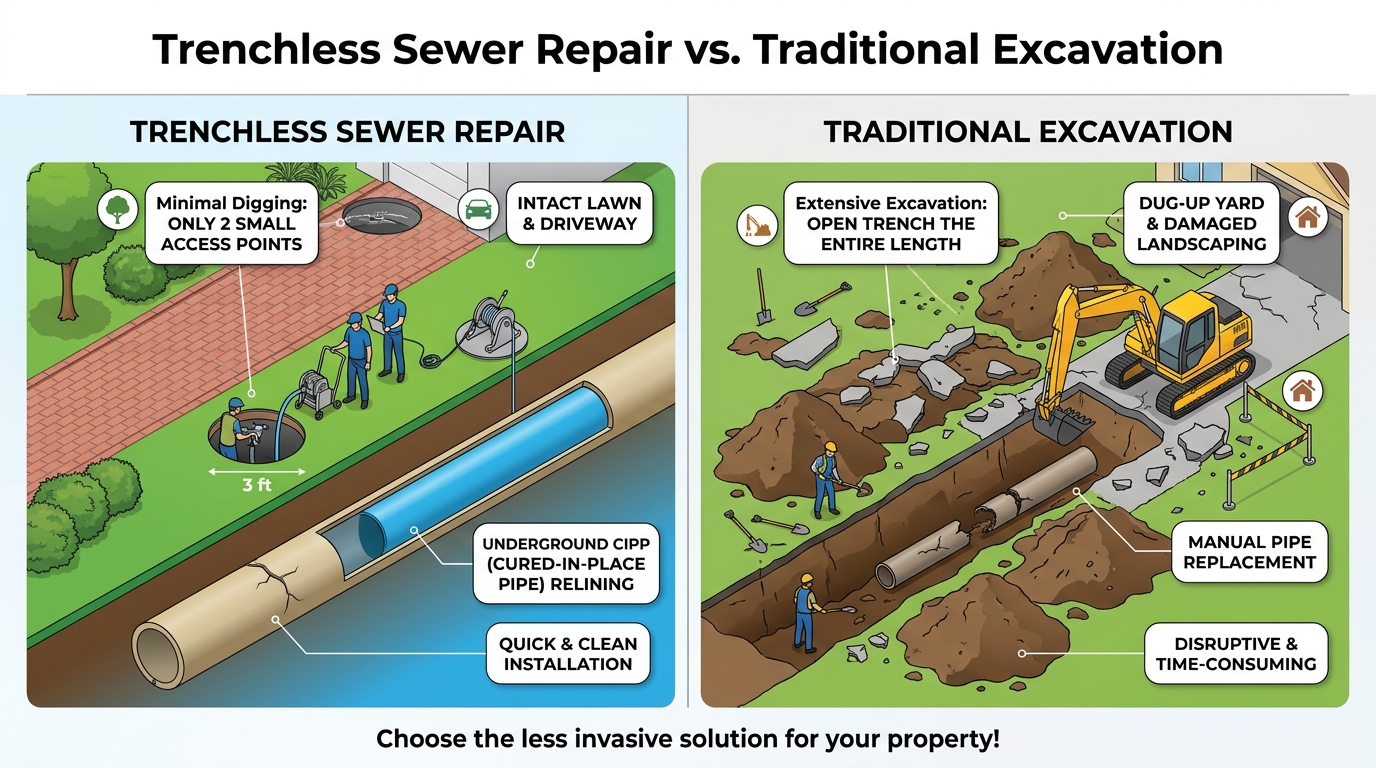
An overview of trenchless sewer repair and traditional excavation examines repair methods, property disruption, costs, and factors affecting repair suitability.
COLLEGEVILLE, PA, UNITED STATES, November 19, 2026 /EINPresswire.com/ — Trenchless sewer repair and traditional excavation are two methods used to address underground sewer line damage. The appropriate approach depends on pipe condition, accessibility, surrounding utilities, and the extent of structural deterioration.
Over time, underground sewer lines can develop cracks, root intrusion, joint separations, and structural deterioration. Addressing these problems may involve trenchless rehabilitation, pipe replacement, or conventional excavation, depending on the condition and location of the damaged pipe.
Understanding Trenchless Sewer Repair Methods
Trenchless sewer repair involves repairing or replacing underground pipes while limiting the amount of surface excavation required. Two commonly used methods are cured-in-place pipe lining and pipe bursting.
Cured-in-place pipe lining involves inserting a resin-saturated liner into an existing pipe. Once cured, the liner forms a new interior pipe surface. This approach is generally considered when the existing pipe can support rehabilitation, and its alignment does not require significant correction.
Pipe bursting involves breaking apart an existing underground pipe while drawing a replacement pipe through the same route. The process typically requires access pits rather than continuous excavation along the full length of the sewer line.
Although trenchless methods can reduce surface disturbance, their suitability depends on pipe condition, accessibility, surrounding utilities, and other site-specific factors.
When Traditional Excavation May Be Necessary
Traditional excavation remains an established method for repairing underground sewer infrastructure. It involves exposing the affected pipe through digging so that damaged sections can be removed, replaced, or repositioned.
Excavation may be required when sewer pipes have collapsed, developed significant alignment problems, or contain sections with improper slopes that cannot be corrected through trenchless rehabilitation.
The method also provides direct access to damaged connections and sections that require structural adjustments.
For properties with limited access or complex underground utility arrangements, excavation may offer a more practical repair approach.
Comparing Property Disruption and Repair Costs
One difference between trenchless sewer repair and conventional excavation is the extent of surface disturbance.
Traditional excavation may require removing portions of lawns, landscaping, sidewalks, patios, or driveways to access underground pipes. Restoration of these areas can contribute to the overall project scope.
Trenchless techniques generally require less continuous digging, although access pits, equipment placement, and localized surface restoration may still be necessary.
Repair costs vary based on pipe depth, length, diameter, material, accessibility, and the severity of damage. Trenchless installation costs may differ from conventional excavation costs, and reduced surface restoration does not necessarily mean a lower total project price in every situation.
Property owners evaluating repair proposals may benefit from reviewing both the proposed pipe work and the anticipated restoration requirements.
Sewer Camera Inspections Help Determine Repair Options
A sewer camera inspection provides visual information about a pipe’s interior condition before repair work begins.
The inspection can help identify cracks, root intrusion, displaced joints, obstructions, and other visible defects. Additional evaluation may be required to determine pipe alignment, surrounding ground conditions, or structural limitations.
Sewer camera inspections can help assess underground pipe conditions and identify visible defects that may influence the selection of pipe lining, pipe bursting, drain cleaning, or conventional excavation.
The company serves property owners across Montgomery, Chester, Delaware, and Bucks counties, along with other communities in Southeastern Pennsylvania.
About Pro Trenchless Services
Pro Trenchless Services is a sewer and drain service company based in Collegeville, Pennsylvania. Its services include sewer camera inspections, trenchless pipe lining, pipe bursting, sewer line replacement, drain cleaning, hydro jetting, and conventional excavation. The company serves residential and commercial properties throughout Southeastern Pennsylvania.
Media Contact
Pro Trenchless Services
Phone: (484) 801-7242
Website: https://protrenchless.com/
Media Contact Name: Timothy Geiger
Pro Trenchless Service
Pro Trenchless Services Southeastern PA LLC
+1 (484) 801-7242
Visit us on social media:
Instagram
Facebook
YouTube
Other
Legal Disclaimer:
EIN Presswire provides this news content “as is” without warranty of any kind. We do not accept any responsibility or liability
for the accuracy, content, images, videos, licenses, completeness, legality, or reliability of the information contained in this
article. If you have any complaints or copyright issues related to this article, kindly contact the author above.

Media gallery