QINGDAO, SHANDONG, CHINA, November 3, 2026 /EINPresswire.com/ — Global critical-mineral supply-chain governance and precious-metal commodity trade continue to rely heavily on fire assay as the definitive arbitration-grade analytical benchmark, despite the rapid proliferation of XRF, ICP-MS and other high-speed instrumental techniques. These modern instruments deliver rapid screening results, yet they cannot fully replace fire assay for high-stakes settlement, ore-resource estimation and third-party arbitration work. Fire assay’s strength lies in its capability for bulk-sample precious-metal collection, delivering traceable gravimetric results accepted across international mineral markets.
Even so, conventional manual fire-assay workflows carry well-documented real-world burdens for operating laboratories. Technicians are repeatedly exposed to high-temperature radiation, lead-bearing fumes and heavy physical labour. Assay reproducibility is heavily tied to individual operator skill, and manual paper logging creates gaps in audit-ready traceability. As occupational-health rules tighten and sample volumes expand worldwide, laboratory managers face a practical question: how to preserve the well-proven chemistry of fire-assay while mitigating human-driven risk and variability.
All-in-one monolithic automated lines are often perceived as the sole automation solution. In practice, many mineral labs operate with mixed-age installed base equipment, constrained capital budgets and variable sample throughput. This article examines modular-architecture fire-assay automation, a flexible transformation approach built around discrete functional units. It explains how modular designs solve real-world pain-points for both green-field laboratories and retrofitted existing facilities, without altering fundamental fire-assay analytical principles.
Practical Operational Pain-Points of Manual Fire-Assay Laboratories
Three recurring real-world constraints highlight why automation demand is growing, even though the core fire-assay chemical workflow remains unchanged.
1.Occupational-health and safety risks at high-temperature workstations Manual workflows oblige staff to perform crucible handling, furnace loading-unloading, pouring and cupel manipulation in direct proximity to 1200 °C operating zones. Thermal burns and exposure to toxic fumes represent persistent hazards. In many jurisdictions, evolving workplace-safety standards raise compliance pressure on mine-site QC and contract-testing laboratories alike.
2.Result variance originating from human subjectivity Many critical workflow steps are operator-driven: flux weighing, crucible mixing quality, visual judgement of cupellation endpoints. Different technicians produce measurable shifts in precious-metal recovery. For arbitration-level testing, this human-origin uncertainty weakens result defensibility for commodity-trade disputes.
3.Inflexible capital barriers for lab modernisation Many existing mineral-assay labs retain functional furnaces and infrastructure. A complete rip-and-replace full-line monolithic system demands large one-time capital outlay. For mid-sized labs with moderate sample loads, full-system replacement delivers poor return-on-investment, creating a gap between recognised operational needs and feasible budget execution.
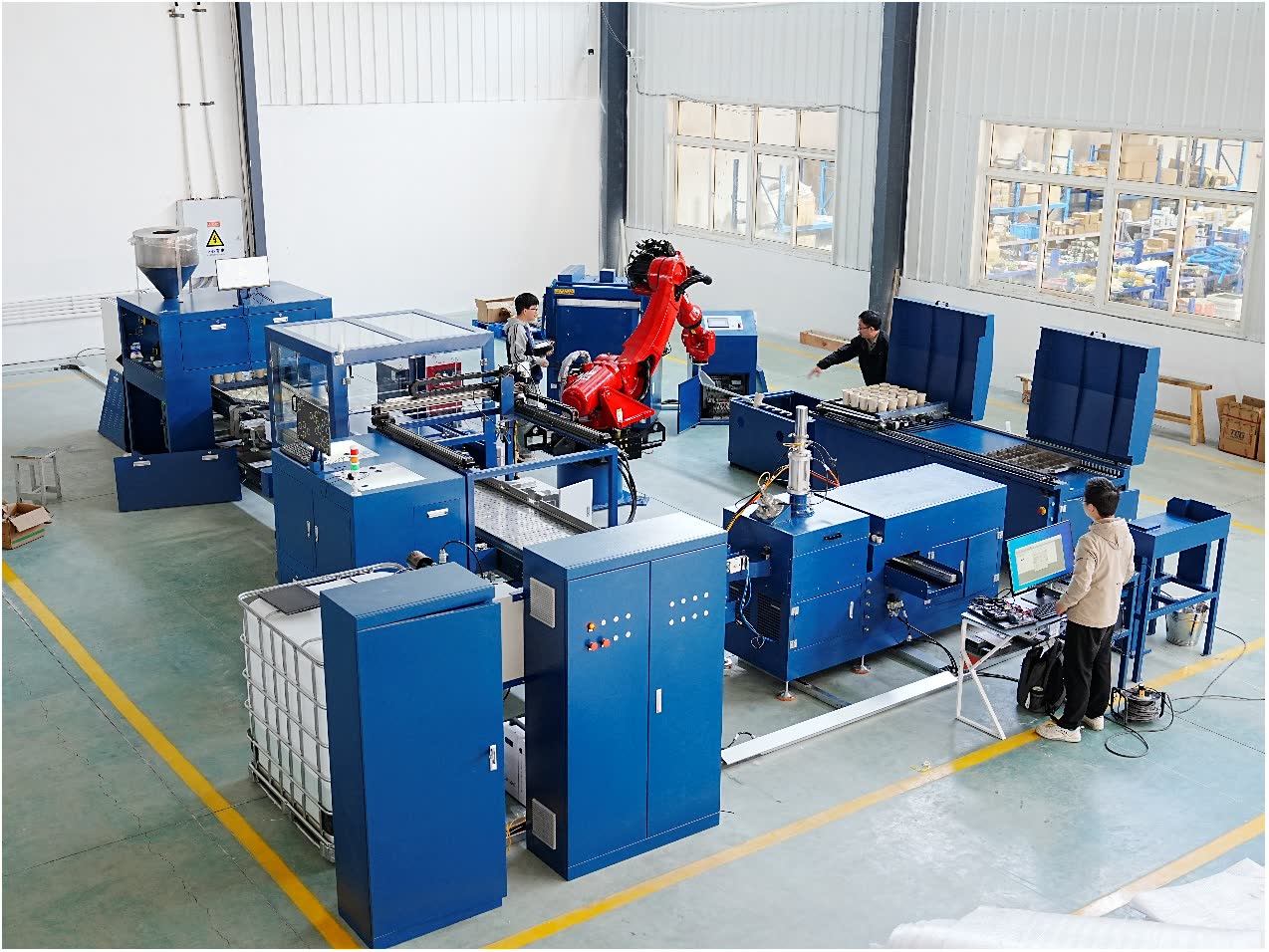
Modular fire-assay automation addresses this gap by decoupling fire-assay workflows into six independent functional building-blocks. Each unit carries its own controller and actuation hardware, and communicates via standard industrial interfaces. Laboratories can upgrade single high-risk stations first, then expand capacity incrementally as operational requirements evolve, rather than committing to a complete line from day-one.
Six Independent Functional Building-Blocks and Their Real-World Deployment Logic
Each module maps precisely to one established fire-assay process step, and supports standalone operation or synchronised full-line linkage. No single unit is strictly dependent upon the rest of the system.
1.Automatic flux-dosing module Performs automated gravimetric flux dispensing to replace manual weighing and batching.
– Standalone-retrofit scenario: Existing melting-cupellation hardware stays in-service; only the batching workstation is upgraded.
– Full-line scenario: Automatically transfers prepared crucibles onward to mixing stations.
– Practical assessment focus: formula-storage capacity, batching precision, cross-contamination prevention for multi-matrix ore programmes.
2.Automated crucible tumbling and covering-agent dosing module Carries out ore-flux homogenisation and quantitative covering-agent addition. Removes outcome variability from manual shaking.
– Standalone-retrofit scenario: used purely for sample pre-treatment, independent of melting-furnace status.
– Full-line scenario: feeds homogenised crucibles downstream toward fusion.
– Practical assessment focus: mixing homogeneity performance, covering-agent dosing consistency, compatibility with standard crucible dimensions.
3.Fusion melting module Executes high-temperature ore fusion, fitted with automated furnace-door actuation and closed-loop thermal control. The furnace unit can run fusion cycles entirely on its own.
– Retrofit scenario: replace an ageing furnace only, while keeping legacy automation-ready peripheral stations. Where old furnaces possess compatible signal interfaces, they may remain in-service alongside new automation modules.
– Full-line scenario: receives crucibles from upstream stations; executes scheduled melting cycles triggered by system signals.
– Practical assessment focus: furnace-chamber temperature uniformity, thermal-retention characteristics, safe signal interlocking with robotic handling hardware.
4.Robotic handling and pouring module Acts as the physical execution node of the automated workflow, performing high-risk tasks: crucible gripping, station-to-station transfer, molten-material pouring and steel-mould inversion.
– Standalone-retrofit scenario: this is the most-frequently deployed single-module upgrade. Labs keep existing furnaces and cupellation hardware; only manual hot-material handling is automated to remove burn-injuries risk.
– Full-line scenario: performs sequenced material transfer linking batching, melting, pouring and cupellation workflows.
– Practical assessment focus: repeat positioning accuracy under sustained high-ambient-temperature conditions, gripper thermal protection, programmable pouring angle and velocity parameters.
5.Automated visual cupellation module Provides automated cupel loading, real-time visual process monitoring and algorithm-driven cupellation-endpoint identification, removing subjective human visual judgement. Completed cupels are individually extracted upon finishing.
– Standalone-retrofit scenario: upgrades only the cupellation workflow while other lab sections remain unchanged.
– Full-line scenario: accepts lead buttons poured from fusion stations to continue the analytical sequence.
– Practical assessment focus: reliability of endpoint-recognition algorithms, batch cupel-holding capacity, long-term stability under continuous high-temperature operation.
6.Central supervisory and data-traceability module Functions as the workflow orchestration hub. It coordinates timing across modules, captures full-process operational parameters, archives event logs and delivers end-to-end audit trails. It supports two operating modes: individual-module debug mode and synchronised full-process-line execution.
– Standalone-retrofit scenario: connects to any subset of already-automated stations.
– Full-line scenario: unifies data collection across all six building-blocks. Critically, fault in one module will not force total system shutdown; unaffected units keep operating.
– Practical assessment focus: industrial-protocol interoperability, process-data persistence, alarm-interlock logic, capability for integration with laboratory LIMS platforms.
Two Core System-Level Advantages of Modular Architecture in Mineral-Lab Practice
1.Phased-investment capacity matching real-world business growth Unlike monolithic all-at-once systems, modular set-ups support staged modernisation. Small-to-mid-volume labs may begin with the robotic handling module to mitigate high-temperature safety hazards. As sample volumes rise over months or years, flux-dosing, cupellation or further units can be added incrementally. New-build laboratories have the option to commission the complete six-module closed-loop workflow from inception.
2.Fault isolation limits operational downtime risk Since hardware and local control logic are decoupled per-module, a fault in one functional unit only halts that specific station. Remaining modules continue normal operation. Standardised interfaces permit fast component swap-out for maintenance, reducing sample backlog and report-delivery delays common with fully integrated monolithic systems.
Key Evaluation Criteria for Modular Fire-Assay Automation Projects
When assessing candidate modular automation solutions, three over-arching technical considerations rise above pure component price comparison.
First, genuine module independence plus standardised-interface implementation. Each unit must complete commissioning and functional testing without connection to the central supervisory host. Inter-module communication should use established industrial protocols, so future hardware expansions do not demand extensive rewriting of existing control software. Suppliers should provide independent performance-test documentation for each discrete module.
Second, process fidelity against established fire-assay standards. Automation hardware must not simplify or alter core fire-assay chemistry merely to ease mechanical implementation. All sequence logic and adjustable process windows must align with globally-accepted fire-assay practice, to preserve analytical validity for accredited and arbitration-grade work.
Third, retro-fit compatibility and total-lifecycle costing. Evaluate to what extent pre-existing functional lab hardware can be retained. Calculate long-term expenses including spare-part availability and maintenance overhead, rather than focusing exclusively on upfront capital quotation.
Clear Operational Boundaries of Modular Automated Fire-Assay Systems
Important practical limits must be acknowledged. Even with comprehensive six-module deployment, total manpower elimination is unrealistic. Manual intervention remains required for initial sample loading, lead-button post-processing, handling anomalous test runs and routine equipment maintenance.
Modular automation delivers highest return-on-investment for labs running sustained, high-volume fire-assay batches. Laboratories with very low throughput and constantly shifting highly diverse sample matrices may find full multi-module deployment economically unjustifiable; selective single-station upgrades represent the more sensible route.
The automated fire-assay system engineered by Qingdao Decent Group adopts this proven six-unit modular architecture. Individual functional modules can operate standalone or be interconnected to establish end-to-end closed-loop workflows. Built around mature fire-assay chemistry, the system replaces repetitive high-temperature manual labour while preserving fundamental assay principles. It supports both green-field complete-line commissioning and phased retrofitting for pre-existing mineral-assay facilities worldwide.
Full technical resource: https://www.decent-group.com/product/automated-fire-assay-system/
Instrumental rapid-analysis techniques continue to expand their footprint within mineral laboratories, yet fire-assay retains its irreplaceable status as arbitration-standard methodology for precious-metal assessment. The real-world challenge for modern labs is not replacing fire-assay chemistry itself, but mitigating safety risks, human-driven variance and traceability gaps of legacy manual workflows.
Modular fire-assay automation offers a pragmatic middle path. Instead of forcing laboratories into large-budget monolithic-system procurement, discrete functional building-blocks enable phased modernisation, fault-isolated operation and reuse of existing valid hardware. Successful deployment depends less on hardware sophistication alone and more on preserving the integrity of underlying fire-assay processes, matched to the actual sample throughput, existing-equipment condition and long-term business trajectory of each individual laboratory.
DECENT
DECENT
Legal Disclaimer:
EIN Presswire provides this news content “as is” without warranty of any kind. We do not accept any responsibility or liability
for the accuracy, content, images, videos, licenses, completeness, legality, or reliability of the information contained in this
article. If you have any complaints or copyright issues related to this article, kindly contact the author above.

Media gallery