
Key Takeaways
- Patients travel through four distinct stages – Curiosity, Research, Evaluation, and Decision – long before they ever book a consultation, and most surgeons only show up at the last one.
- AI tools like ChatGPT and Google AI Overviews now actively shape which surgeons patients discover, making AI visibility a non-negotiable part of modern practice growth.
- Multi-platform content distribution – covering 8 formats across hundreds of platforms – dramatically multiplies both organic reach and AI citation likelihood compared to single-channel strategies.
- Organic content authority compounds over time, unlike paid ads, which stop the moment the budget runs out – making it a higher-leverage long-term investment for patient acquisition.
- The CREDibility Pathway framework, and how to use it to build predictable patient flow, is explained in detail below.
Most plastic surgery practices are competing hard for patients they never actually had a chance to win – not because of pricing, not because of skill, but because they were invisible at the wrong moment. Understanding when and where patients form their preferences changes the entire game.
Patients Research and Decide on Their Surgeon Long Before Booking
By the time a prospective patient picks up the phone or fills out a contact form, the decision is often already made. Consumer behavior research shows that 92% of consumers will research a business before purchasing – and for elective procedures, that research window stretches across weeks or even months. Patients are reading articles, watching videos, comparing surgeons, scanning reviews, and asking AI tools for recommendations.
The implication for plastic surgery practices is significant. A surgeon with a polished website and strong ad spend can still lose patients to a competitor who showed up earlier and more consistently during the research journey. MedFire Media built their OmniDominance™ AMP system around this insight – positioning surgeons as trusted authorities across every stage of that journey, not just the final booking moment.
Understanding this requires a closer look at how patients move from first awareness to booked consultation.
The CREDibility Pathway Explained
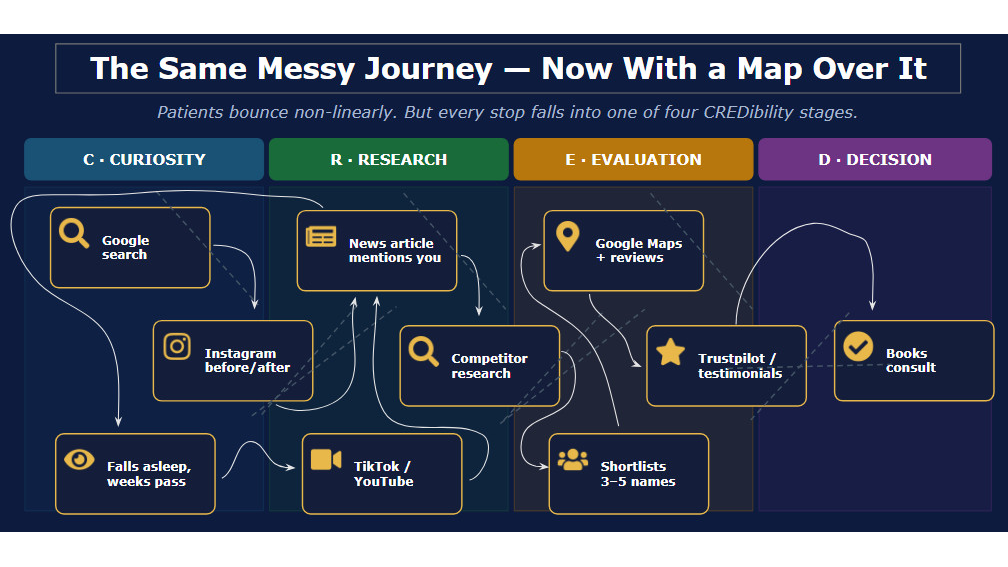
The CREDibility Pathway maps the four stages every patient travels before they ever schedule a consult. The acronym breaks down simply: C for Curiosity, R for Research, E for Evaluation, and D for Decision.
Curiosity: The Avoidance Phase
The first stage is almost never about surgery. A prospective rhinoplasty patient is not searching for best rhinoplasty surgeon near me at the start. They are searching for how to slim nose without surgery or non-surgical nose job options. This is the avoidance phase – patients are curious about their concern but actively looking for ways to sidestep a surgical solution. They have not committed to anything yet.
Surgeons who publish content addressing these early, non-surgical questions earn trust and familiarity at this stage. Those who do not are simply absent from the conversation.
Research to Decision: The Three Remaining Stages
Once a patient accepts that surgery may be the right path, they enter the Research stage – light exploration of procedures, costs, and recovery. Next comes Evaluation, the in-depth due diligence phase where they compare surgeons, read reviews, look for before-and-after galleries, and seek third-party validation. Finally, the Decision stage is where the consultation gets booked.
Most practices invest heavily in the Decision stage – ads, landing pages, review generation – while remaining invisible during Curiosity, Research, and Evaluation. The result is entering a race already lost to whoever showed up first.
Why Surgeons Lose Patients They Never Meet
The Hidden Cost of Showing Up Late
There is a measurable cost to late visibility. Businesses using three or more channels can see a 250% higher purchase rate compared to single-channel strategies. A patient who has read an article, watched a video, listened to a podcast episode, and seen social content from the same surgeon arrives at the Decision stage with trust already built. A surgeon they discover for the first time via a Google Ad at that same moment is starting from zero.
Research shows that 88% of consumers trust online reviews as much as personal recommendations. Referrals are valuable – but they no longer close the deal on their own. The digital footprint still has to be there.
AI Tools Now Shape Who Gets Recommended
Patients increasingly turn to AI tools – ChatGPT, Google AI Overviews, Perplexity, Microsoft Copilot – not just to search, but to ask direct questions and receive curated recommendations. Queries like what should I look for in a rhinoplasty surgeon now return AI-generated answers that cite specific sources. If a surgeon’s content is not among those sources, they do not get mentioned – regardless of how strong their clinical results actually are.
AI Visibility Is the New Credibility Signal
Research tracking Google AI Overviews found that coverage for treatment-related healthcare queries reached 100% by December 2025. For virtually any procedure a patient searches, they are likely receiving an AI-generated answer before they ever click on a website. Being the source that AI pulls from is now a direct patient acquisition factor.
How ChatGPT and Google AI Overviews Pick Their Sources
AI models do not favor sources based on geography or niche relevance – they weight authority, breadth of presence, and consistency of information across independent contexts. A plastic surgeon brand mentioned in a Yahoo Finance article, a podcast on Spotify, a news article on USA Today, and a video on YouTube sends a signal that no single high-quality website can replicate on its own. The AI reads all of it, and that volume of independent citations is what earns the recommendation.
Multi-Platform Content Drives the Numbers
One Piece of Content, 8 Formats
The OmniDominance™ AMP system is built around a core content multiplication principle. Every campaign begins with a single news article, which is then transformed into eight distinct formats:
- News Article – distributed to major media affiliates including USA Today, Business Insider, AP News, and Google News-approved sites
- Blog Post – optimized for search and citation, published across editorial platforms
- Short-Form Video (Reel/Short) – distributed to YouTube Shorts, Instagram, and TikTok
- Long-Form Video – published to YouTube and Vimeo
- Podcast Interview – distributed to Spotify, Apple Podcasts, Amazon Music, and Podbean
- Infographic – shared to Pinterest and visual content platforms
- Flipbook/eBook – published to SlideShare, Cameo, and document sites
- Social Posts – auto-formatted for LinkedIn, X, and thousands of social networks via RSS feed
The result is a single well-researched answer to a patient question living across hundreds of platforms in formats optimized for each audience and each discovery context.
How Format Diversity Improves AI Discoverability and Citation Likelihood
AI training data scrapes podcasts, YouTube, SlideShare, news sites, and blogs. Each format feeds AI systems from a different angle. A single blog post on one site offers one citation opportunity. The same content transformed into 8 formats and distributed across hundreds of platforms creates dramatically expanded surface area – and more surface area means more chances to be the source an AI tool cites when a patient asks the right question.
Internal testing of distribution stacking showed that single-tier distribution returned 1x the AI citations, while a 5-tier stacked distribution of the same content returned 14x the citations – same product, same week, same article. Only the distribution breadth changed.
The OmniDominance™ AMP System in Practice
Audience Intelligence: Mapping Thousands of Patient Questions
Before any content is created, the process begins with mapping the full CREDibility Pathway for a practice’s core procedures. There are thousands of questions a prospective patient might ask about a single procedure – spanning every stage from early curiosity to pre-booking evaluation. Identifying which questions are being asked at each stage, including what people ask AI tools specifically, determines the entire content strategy.
Authority Content Creation: Handled by the MedFire Team
The practice provides expertise about their services. MedFire Media’s specialist team handles everything else – research, writing, formatting, and production across all 8 content formats. This removes the bottleneck that stops most practices from executing a consistent content strategy: the surgeon does not have to write a single word or edit a single video.
Distribution: Broad Reach Across Hundreds of Platforms
Once created, content is distributed across 300+ trusted sites and platforms – including Google News affiliates, YouTube, Spotify, Pinterest, Medium, and major news networks. Higher-tier distribution options add placements on MSN (Domain Authority 83, 700M+ monthly visitors), USA Today, Business Insider, and AP News. Each placement adds another independent citation context, compounding authority over time rather than resetting with each campaign.
Organic Authority Outlasts Paid Ads
Paid ads deliver immediate visibility with a hard stop – the moment spend pauses, the presence disappears. Organic content authority works the opposite way. A news article published today can still be surfaced by an AI tool or ranked in organic search two years from now. BrightEdge data shows that 53% of all trackable website traffic comes from organic search. Nielsen Norman Group research found that 70% of users believe high-ranking sites are more credible than competitors – a trust signal no ad placement can manufacture.
The compounding nature of content – where each new piece adds to an existing network of citations, backlinks, and authority signals – means the return on content spend grows over time rather than decaying. For practices thinking about patient acquisition as a long-term asset rather than a monthly expense, this distinction matters enormously.
Become the Surgeon AI Recommends – Before Patients Even Search for You
The practices that will dominate patient acquisition over the next several years will not necessarily be the ones with the biggest ad budgets. They will be the ones whose names, expertise, and answers to patient questions are distributed broadly enough across the internet that AI tools and search engines have no better source to recommend. That kind of authority is not built in a single campaign – it is built through consistent, multi-format, multi-platform content that answers real patient questions at every stage of the CREDibility Pathway.
The surgeons who start building that presence now are the ones patients – and AI – will find first.
MedFire Media helps board-certified plastic surgeons build that presence through their fully managed OmniDominance™ AMP system – visit medfiremedia.com to learn more.
MedFire Media
enquiries@medfiremedia.com
101 Woodsedge
Waterlooville
Hampshire
PO7 8PX
United Kingdom


